Singapore is a city of west-facing windows and 32°C afternoons, and yet almost every flat here still opens its curtains by hand. It’s the last genuinely dumb thing in an otherwise automated home — you’ll happily spend S$400 on a robot vacuum for a floor you barely look at, then spend two years yanking a dim-out curtain across a 3-metre track every evening.
Motorised curtains used to be a landed-property luxury: custom tracks, an electrician, four figures. Not any more. In 2026 there are retrofit motors that clip onto the rod you already have, roller-shade drivers that grip the existing bead chain, and wired track motors that cost less than a mid-range aircon service contract. The catch is that the market splits down the middle: cheap retrofit robots that need a proprietary hub, and Matter-over-Thread motors that don’t but cost roughly twice as much.
Here’s what actually works in an HDB or a condo, what it costs in SGD, and where each option falls over.
First, work out which of the four setups you have
Almost every window covering in Singapore falls into one of four buckets, and the bucket determines the product. Get this wrong and you’ll be repacking a box.
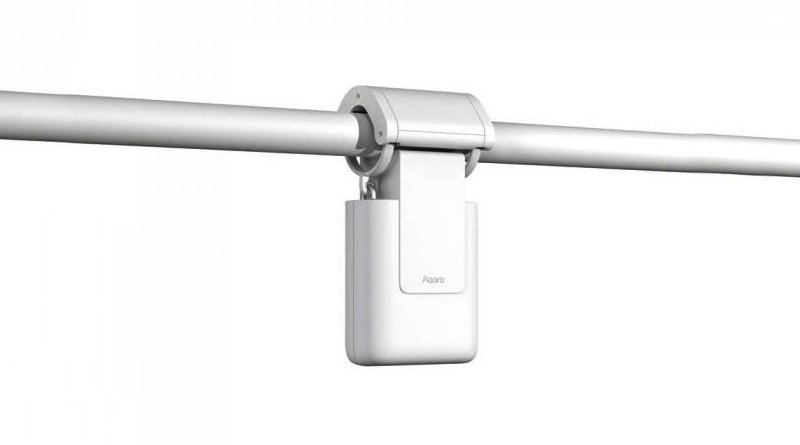
Curtains on a round rod. Common in rental units and older flats. A retrofit robot clips onto the rod and drags the curtain along by gripping it. SwitchBot’s rod unit covers 15–40 mm diameters, which takes in essentially every domestic curtain rod sold here.
Curtains on a track (U-rail or I-rail), usually hidden behind a pelmet. This is the default in most BTOs and condo handovers. You can either retrofit a robot into the track, or replace the whole track with a motorised one.
Roller or zebra blinds with a bead chain. Very common on kitchen and bedroom windows, and on condo balconies. A chain driver grips the beads and pulls them for you. No track surgery.
Venetian blinds with tilting slats. Less common here, but they exist in older walk-ups and offices. Only one product really addresses these properly.
If you’re not sure which track type you have, look up at the rail. A U-rail has a channel with a slot on the underside; an I-rail is a flat bar with runners hanging off it. HomeSmart’s guide to ordering Aqara smart curtains walks through measuring properly before you buy, which is worth ten minutes of your time.
The retrofit robots: cheapest way in
SwitchBot Curtain 3 — the one to buy if you rent
The Curtain 3 is the default recommendation for most people, and especially for renters, because it involves zero permanent modification. It clips on, it calibrates itself, and when you move out it comes off in ten seconds and goes in a shoebox.
Specs that matter: it’ll pull up to 15 kg of curtain, weighs 280 g, runs off a 3350 mAh 18650 cell, and takes 15–40 mm rods. The headline number is noise — 42 dB in normal mode, but roughly 25 dB in QuietDrift mode. That’s the real upgrade over the older Curtain 2, which sounded like a small robot dragging fabric across a rail, because it was. QuietDrift is quiet enough to run at 7 a.m. without waking a partner; you trade speed for it, and a slow sunrise open is arguably the nicer behaviour anyway.
Battery life is better than this category’s reputation suggests: SwitchBot rates it at up to 8 months on a single charge, assuming one open-and-close cycle a day. Run it four times daily on a west-facing window and you’ll see a fraction of that, but for a bedroom curtain the claim is not unreasonable. There’s a Solar Panel 3 sold separately if you want to stop thinking about it entirely — though on a Singapore window with a deep overhang or a solar film on the glass, it will underperform the marketing photos.
It comes in three flavours: Rod Type (78 × 71 × 205 mm), U Rail (66 × 51 × 173 mm), and an I Rail accessory kit sold separately. Official pricing is US$99.99 for the rod version and US$89.99 for the U-rail, with the I-rail kit at US$9.99. Locally, Horme lists the Curtain Rod 3 at S$119 including GST — check stock across their outlets, as it moves in and out at individual branches. Otherwise Amazon.sg is the usual route, and prices there swing with shipping.
The important asterisk: out of the box it’s Bluetooth only. You get app control within range and that’s it. For remote access, schedules that survive your phone leaving the flat, and voice control, you need a SwitchBot hub. For Matter — and therefore for Apple Home — you specifically need the Hub 2 or a Matter-enabled Hub Mini. Budget for that. A Curtain 3 without a hub is a solved problem for one window; a Curtain 3 with a hub is a smart home device.
Two units are needed for a centre-parting curtain. Nobody enjoys discovering this at checkout.
Aqara Curtain Driver E1 — buy this if you already run Aqara
If you already have an Aqara hub on the wall, the Curtain Driver E1 is the more sensible buy. Its 6000 mAh cell is rated at up to a year per charge against SwitchBot’s 8 months — both are manufacturer figures on a once-daily cycle, so treat the gap as directional rather than precise, but the Aqara has close to twice the capacity and it shows.
A year between charges is the difference between a smart home device and a chore. You’ll charge it when you change the aircon filter and forget about it in between.
It comes in Rod and Track versions (the rod version handles rods, U-rails and I-rails; the track version does rails only, and is cheaper). There’s a built-in light sensor for brightness-triggered automations, USB-C for permanent power if you have a point nearby, and support for two drivers on one window for centre-parting curtains. Locally it runs S$140–150 through PFE Tech.
Two honest limitations. First, max load is 12 kg, against the SwitchBot’s 15 kg. That sounds academic until you hang a lined dim-out curtain across a 3-metre living room window — heavy blackout fabric with a proper lining gets there faster than you’d think. Weigh your curtain before you commit. Second, it’s audibly louder than the Curtain 3; reviewers have consistently flagged this, and there’s no equivalent of SwitchBot’s QuietDrift mode. In a bedroom on a 7 a.m. sunrise routine, that matters — and it’s the single strongest argument for spending the extra on the SwitchBot instead.
Protocol-wise it’s Zigbee 3.0 and it needs an Aqara hub — always. It reaches Matter ecosystems by being bridged through a Matter-capable Aqara hub such as the M3 or the compact M100, not natively. If you’re picking a hub for the first time, HomeSmart’s how to choose an Aqara hub guide is the shortcut.
Aqara Roller Shade Driver E1 — for bead-chain blinds
Different product, same family, and the cheapest entry point on this list at S$100 locally. The Roller Shade Driver E1 (model RSD-M01) grips a beaded chain of 3–6 mm and pulls it, which means it works with roller shades, zebra blinds and honeycomb blinds without touching the blind itself. It’s 42 × 37 × 165 mm and mounts beside the chain.
Be realistic about the battery: Aqara’s own spec sheet rates standby at two months, assuming a 1.8 m × 1.8 m shade cycled up and down once a day. Two kitchen blinds and a bedroom blind means charging something every few weeks, which gets old. If there’s a socket within reach, run it on USB-C permanently and treat the battery as a UPS. The cell isn’t user-replaceable either, which caps the device’s realistic lifespan — a recurring theme worth reading up on in how Singapore buyers can avoid getting bricked.
SwitchBot Blind Tilt — the only real answer for venetians
If you have venetian blinds, Blind Tilt is basically the category. It tilts slats to the nearest 2°, runs off a 2000 mAh battery, and — unusually — ships with the solar panel included, which makes it the one battery device here you can genuinely fit and forget. It’s 48.8 × 29.2 × 144.2 mm and 130 g. US$69.99 officially; there’s no formal Singapore retail channel, so Amazon.sg or direct import is the route, and landed cost varies enough that it’s worth checking both before ordering.
Same hub caveat as the Curtain 3: Bluetooth alone out of the box, Hub Mini for remote and voice, Hub 2 for Matter and Apple Home.
The wired motors: better, but plan them during reno
Retrofit robots are a compromise. They’re visible, they’re battery-powered, and they drag fabric rather than drive it. A proper motorised track is quieter, faster, stronger and invisible behind the pelmet. The price of that is a power point at the window — which is why this decision belongs in your renovation, not after it.
Aqara Curtain Controller C3
The C3 is a wired Zigbee track motor rated for 80 kg of curtain with 2 N·m of torque, running at 26 dB at its lowest speed. Eighty kilos is an absurd amount of curtain — this will move a full-height, floor-to-ceiling lined dim-out across a 4-metre condo window without complaint, which is exactly where the 12 kg retrofit drivers give up. It uses 9-pair Hall positioning for precise real-time feedback, has adjustable travel limits and adjustable speed, and critically, it still opens by hand if the power goes out. It’s S$369 locally.
Like the E1 it’s Zigbee 3.0 and needs an Aqara hub; it reaches Matter through a bridging hub, not natively.
Aqara Roller Shade Controller T1S
For roller shades done properly, the T1S is a tubular motor that lives inside a 38 mm shade tube. It runs at 25 rpm at under 27 dB, works with roller, zebra, Shangri-La and honeycomb blinds, and supports Matter over bridge. Nice touch: the Aqara Home app can open or close it gradually over a preset period — 30 minutes, say — so a bedroom shade eases open with the sunrise rather than snapping up at 7:02.
Wire for this before the walls close
Both wired motors need a 13A point or a fused spur at the pelmet. In a BTO, that’s a five-minute conversation with your ID during electrical marking-out and a couple of hundred dollars; after handover, it’s surface trunking or a hacked wall. This is precisely the kind of thing that belongs on your smart home wiring checklist before the walls close.
The Matter-over-Thread option: no hub, more money
Everything above needs a manufacturer hub to reach Matter. If you’d rather skip the middleman entirely, two options speak Matter over Thread natively.
Eve MotionBlinds Upgrade Kit is the premium pick — a tubular motor for existing roller blinds that speaks Matter over Thread with no bridge at all, working directly with Apple Home, Google Home, SmartThings and Home Assistant. It comes in two sizes: €149.95 for 25–30 mm tubes and €199.95 for 38–51 mm tubes (US$199.95 in the States). There’s no Singapore retail presence, so you’re importing.
Zemismart MTP1 is the value play: a Matter-over-Thread bead-chain driver with three interchangeable cogs for 3–6 mm chains, a 6400 mAh battery rated around six months, a rotary dial for manual positioning and three speed settings. Around US$104.99 direct. SmartHomeScene’s review rates its build quality above comparable chain drivers.
The honest caveat: “no hub” isn’t quite true. Thread devices need a Thread border router — a HomePod mini, an Apple TV 4K, a Nest Hub, an Aqara M3, or an increasing number of routers. You’ve swapped a proprietary hub for an infrastructure requirement. And Thread through HDB’s reinforced concrete is its own project; we’ve written about building a bulletproof Matter mesh through concrete walls and about Wi-Fi 7 routers with built-in Thread border routers if you’re starting from scratch.
One thing Matter does handle well here: the Window Covering cluster has been part of the standard since day one, so position control, open/close and tilt are all properly defined. This isn’t a category where Matter support is half-finished.
What about IKEA?
Reasonable question, given IKEA’s smart blinds were the budget answer for years. Bad news: TREDANSEN and PRAKTLYSING left IKEA’s range in autumn 2025, so anything still on a shelf here is clearance. They were Zigbee via the TRÅDFRI gateway rather than Matter or Thread — a discounted end-of-line blind on a discontinued platform is not the bargain it looks like. Skip it.
The Singapore case for automating this at all
Beyond the convenience, there’s a real thermal argument in a tropical climate. The US Department of Energy puts the potential reduction in heat gain from smart management of window coverings at up to 77% — the operative word being management. A blackout curtain only cuts your aircon load if it’s closed at 2 p.m. when the west sun is hitting the glass, and nobody is home at 2 p.m. to close it.
That’s the automation worth building: close the living room curtains when the light sensor crosses a threshold, or simply on a schedule between 1 p.m. and 5 p.m. on weekdays. The Aqara Curtain Driver E1’s built-in light sensor makes this trivial without buying a separate sensor. Pair it with a smart plug or clamp meter and you can actually measure whether it’s working — see our guides to energy monitoring smart plugs and whole-home energy monitoring.
What we’d actually buy
Renting, one window, want it done this weekend: SwitchBot Curtain 3 (S$119 at Horme) plus a Hub 2 if you want Apple Home. Nothing permanent, packs away when you move.
Already have an Aqara hub: Curtain Driver E1 at S$140–150 — provided your curtain is under 12 kg and the noise doesn’t bother you. For a living room curtain you open once a day, it’s the better buy. For a bedroom, pay the difference for the Curtain 3’s QuietDrift mode.
Bead-chain roller or zebra blinds, on a budget: Aqara Roller Shade Driver E1 at S$100 — but run it on USB-C power if you possibly can. Two months per charge is a nuisance.
Mid-renovation, heavy floor-to-ceiling curtains: Aqara Curtain Controller C3 at S$369, and tell your electrician now. Eighty kilos of capacity and 26 dB is a different class of product from anything that clips on.
Committed to Matter and allergic to hubs: Eve MotionBlinds if budget is no object, Zemismart MTP1 if it is. Confirm you have a Thread border router first.
The trap to avoid is buying a retrofit robot for a curtain that’s too heavy for it, which is by far the most common mistake here. Weigh the curtain. Twelve or fifteen kilos sounds like a lot until you’re holding a lined dim-out panel for a 3-metre window.
If you’re assembling a first system rather than solving one window, our under-S$300 starter kit is a better starting point than any single motor — and for the full no-drill rental approach, the SwitchBot renter’s guide covers the rest of the flat. Readers outside Singapore should head to our sister site Smartifiers for global pricing and availability.