Why Smart Smoke and Gas Detectors Matter More Than You Think in Singapore
If you’re reading this from a HDB flat built before 2018, there’s a decent chance the only “fire alarm” in your home is the smell of charred kaya toast. The Singapore Civil Defence Force (SCDF) only made Home Fire Alarm Devices (HFADs) mandatory for new residential premises and homes undergoing fire safety renovations from 1 June 2018 onwards. If your flat predates that and you’ve never renovated, you’re operating on vibes and a fire extinguisher you probably haven’t checked since key collection.
The good news: smart smoke detectors have gotten genuinely good. They no longer false-alarm at every wok hei session, batteries last a decade instead of nine months, and the better ones will ping your phone the moment something goes wrong — whether you’re in the next room or in Bali.
The slightly less-good news: most smart detectors are designed for North American or European homes, where natural gas piping, central HVAC, and hardwired smoke alarms are the norm. Translating them to a Singapore HDB or condo takes a bit of judgment. So here’s what actually works, what’s worth your money, and what to avoid.
A Quick Note on SCDF Compliance
Before we get into the products: not every smart detector on this list is SCDF-listed. SCDF maintains a list of HFAD products that meet local certification requirements (typically EN 14604 with additional checks). If you’re submitting plans for a fire safety renovation, you must use a SCDF-listed unit — your Qualified Person will tell you. For everyone else (existing flats, voluntary upgrades, additional protection in bedrooms), you can install whatever you trust.
Smart units sit in an awkward middle ground. They’re not always SCDF-listed, but they shouldn’t replace your primary HFAD if you have one — they should augment it. Put the SCDF-listed unit where the regulation says (typically near the bedroom corridor), then add smart detectors elsewhere for kitchen monitoring, the yard, the helper’s room, and so on.
For more on building out a layered Singapore smart home in general, HomeSmart’s Smart Home Singapore guide is a solid starting point.
Aqara Smart Smoke Detector — Best Overall for HDBs
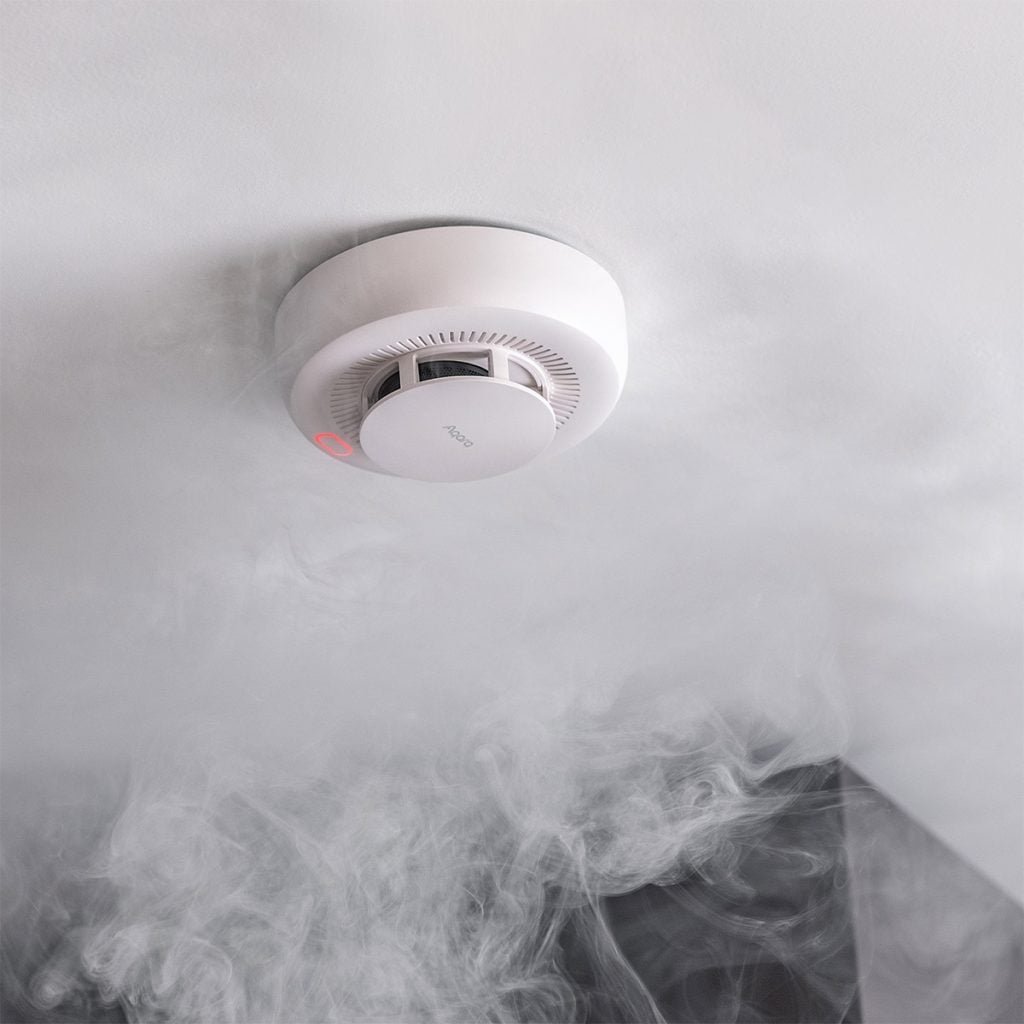
If you’ve already got an Aqara hub running (M2, M3, or any of the camera hubs), the Aqara Smart Smoke Detector is the easiest and most cost-effective addition. It runs around S$33 locally, which is about a third of what HomeKit-native alternatives cost, and it slots straight into the Aqara Home app, Apple Home, Google Home, and Alexa via Matter over Bridge.
Specs that matter:
- Photoelectric smoke sensor (good at smouldering fires — the slow, deadly kind)
- 85 dB built-in siren (loud enough for a typical 4-room flat)
- 10-year battery life (CR17450 lithium, non-replaceable)
- Zigbee 3.0 (low power, mesh-extending)
- Test button + tamper detection
The killer feature is the multi-device linking: if one detector trips in the kitchen, every other Aqara smoke detector in the house screams along with it. This matters in a HDB layout where bedrooms can be 8–10 metres from the kitchen with two doors in between — a single 85 dB alarm in the kitchen doesn’t reliably wake a sleeping adult.
The catch: It needs an Aqara hub to do anything smart. If you don’t have one, the Aqara Hub M3 (which we compared against Home Assistant Green here) is the current sweet spot. The detector also isn’t SCDF-listed at the time of writing, so don’t use it as your sole HFAD if you’re submitting reno plans — use it as a smart layer on top.
Netatmo Smart Smoke Alarm — Best Pure HomeKit Option
For an Apple-only household that doesn’t want a hub, the Netatmo Smart Smoke Alarm is the cleanest install in this entire roundup. It connects directly to your Wi-Fi, registers with Apple Home natively (no bridge required), and shows up as a HomeKit sensor you can use in automations — flash all the lights when smoke is detected, unlock the door, kill the aircon, whatever you want.
Specs:
- Photoelectric sensor, 85 dB alarm
- 10-year sealed lithium battery (no replacements)
- 2.4 GHz Wi-Fi only (which is fine — most ceiling spots get 5 GHz poorly anyway)
- Native HomeKit, no hub needed
The catch: Netatmo isn’t officially distributed in Singapore, so you’re either parallel-importing or ordering from Amazon UK/EU. Expect to pay roughly S$170–220 landed, plus you forfeit local warranty support. For most HDB owners that’s a hard sell when the Aqara unit costs a fifth of that. But if you’ve built your entire home around Apple Home and refuse to add a hub for a single sensor, this is the one.
First Alert SC5 — The Nest Protect Replacement (If You Can Get It)
Google quietly killed the Nest Protect in March 2025, and existing units will keep working until their expiration date. The official replacement is the First Alert SC5 Smart Smoke & Carbon Monoxide Alarm, launched in partnership with Google. It works seamlessly with the Google Home app, snaps onto the Nest Protect’s existing baseplate, and adds proper CO detection.
Specs:
- Photoelectric smoke + electrochemical CO sensor (combo unit)
- 10-year battery and hardwired versions both available
- Google Home app integration
- US$129.99 list price
The catch: Singapore availability is essentially nil right now. First Alert isn’t widely distributed here, and the SC5 was rolled out to the US and Canada first. If you’ve still got Nest Protects from a few years back, hold on to them until they expire — Google has confirmed they’ll keep getting security updates. If you’re shopping fresh in Singapore in 2026, this isn’t the unit for you yet.
X-Sense SC07 Series — Best Combo Smoke + CO
If you want both smoke and carbon monoxide detection in a single unit and don’t care about HomeKit, the X-Sense SC07-WX is hard to beat on value. CO is rare in Singapore homes (we don’t burn fossil fuels indoors at scale, and we don’t have basement boilers), but anyone with gas water heaters, gas hobs in poorly-ventilated kitchens, or charcoal-grill obsessions should consider one.
Specs:
- Photoelectric smoke + Figaro electrochemical CO sensor
- ETL-listed, meets UL 217 and UL 2034 standards
- 10-year sealed battery (CR123A x 2, non-replaceable)
- Direct 2.4 GHz Wi-Fi to the X-Sense Home Security app
- Real-time push notifications for alarms, low battery, and faults
The SC07-MR variant adds wireless interconnection between multiple X-Sense detectors plus optional fire dispatch service. The interconnect range is generous enough to cover a 5-room HDB end-to-end.
The catch: X-Sense doesn’t integrate with Apple Home, Google Home, or Matter — it lives entirely inside its own app. That’s a deal-breaker if you’ve built routines around HomeKit or SmartThings, but fine if you just want a reliable smart smoke + CO detector that texts you when it screams. Pricing in Singapore via parallel import lands around S$80–120 for a single SC07-WX.
Aqara Smart Gas Detector — Singapore’s Asterisk
Here’s where Singapore-specific nuance kicks in hard, and where I have to be honest about what this product is and isn’t. The Aqara Smart Gas Detector is designed to detect methane (CH4) — the main component of natural gas. It does not detect Liquefied Petroleum Gas (LPG), which is heavier than air and used in homes with cylinder gas.
The wrinkle: most Singapore HDBs on piped gas receive town gas from City Energy (formerly City Gas), and town gas is a different beast from natural gas. It’s roughly 41–65% hydrogen, with methane as a smaller component. A pure methane sensor may or may not trigger reliably on town gas leaks depending on hydrogen levels at the source — it’s not what the sensor is calibrated for. Aqara markets this as a natural gas detector, and that’s how I’d treat it.
So the practical guidance:
- If your home is on natural gas (some condos and a small number of newer developments connect directly to the natural gas grid): the Aqara detector is appropriate.
- If your home is on piped town gas (most HDBs and many older condos): treat the Aqara as supplementary at best, and don’t rely on it as your only gas leak protection. A dedicated SCDF-approved town gas detector from a local fire safety shop is the safer choice.
- If your home uses LPG cylinders: skip the Aqara entirely and get a wall-low-mounted SCDF-approved LPG alarm. Smart LPG detectors with proper Apple/Google/Matter integration still don’t really exist in Singapore as of 2026.
Specs:
- Methane detection only (CH4)
- 85 dB built-in siren
- Mains-powered (12V/0.5A — needs a plug nearby; this is awkward for kitchens)
- Zigbee 3.0
- Group binding: one detector triggers others even if hub goes offline
- ~S$70 locally
Where to install it: Within 1–2 metres of your stove, mounted high (methane is lighter than air and rises to the ceiling — the opposite of LPG/CO sensors which should mount low). Don’t put it directly over the wok or it’ll false-alarm on cooking vapour.
What About the Built-in HDB HFAD?
If you’ve moved into a HDB flat built or renovated after June 2018, you already have a basic photoelectric smoke alarm — typically a sealed 10-year unit installed near the bedroom corridor. These are SCDF-compliant by definition and they work. They’re just dumb: they scream locally and that’s it.
The cleanest upgrade strategy in 2026 is don’t replace the SCDF unit — just add a smart detector somewhere it actually adds value:
- Kitchen / yard: Where most fires actually start in HDBs (oil fires, forgotten kettles, dryer lint). The Aqara Smoke Detector here, paired with an Aqara dual relay on the kitchen exhaust fan, can auto-vent the moment smoke is detected.
- Bedrooms: A second, linked alarm in each bedroom dramatically improves wake-up reliability, especially for households with kids or grandparents who sleep with the door closed.
- Helper’s room / store room: Often the furthest point from the SCDF unit and home to a lot of dusty electronics and chargers.
Automations Worth Setting Up
Once your smart detectors are talking to your hub, the real value comes from the automations. A few that genuinely earn their keep in Singapore:
- Kitchen smoke → kill the aircon, open the windows (figuratively). Trigger the Aqara smoke detector to switch off the master aircon and any room aircons via your IR blasters or Matter aircons. This stops the AC from spreading smoke through the whole flat.
- Smoke detected at night → flash hallway lights. A blinking Aqara LED bulb in the hallway helps you find the door fast in low visibility. This is more useful than people realise — smoke disorients you faster than the alarm wakes you up.
- Smoke detected → push notification + CCTV snapshot. Pair the smoke detector with an Aqara Camera G3 pointed at the stove, so you can verify whether something is actually burning or it’s a sensor glitch before sprinting home from work.
- Away mode + smoke alert → automatic emergency contact. This is harder to set up cleanly in Apple Home, but doable in Home Assistant or via SmartThings routines.
What I’d Actually Buy
For most HDB owners reading this in 2026, the answer is unromantic: start with the Aqara Smart Smoke Detector if you already have an Aqara hub for around S$33, and you get real smart home integration with Apple Home, Google Home, Alexa, and Home Assistant. Add a smart gas detector only if you’re on natural gas (rare in Singapore residential), and stick with a SCDF-approved non-smart unit for town gas or LPG.
If you’re a HomeKit purist who refuses hubs, the Netatmo is your only real option — and you’ll pay roughly double for the privilege.
If you want the absolute best smoke + CO combo and don’t care about smart home ecosystem integration, the X-Sense SC07-WX is the value pick.
And if you’re moving into a brand new BTO: don’t rip out the HFAD. Just add a smart detector to the kitchen, link your bedroom lights to it, and you’ve upgraded a passive safety device into something that actually does work for you while you sleep.
The fire that takes down a Singapore flat is almost never the dramatic kind. It’s a kettle left on overnight, a phone charger that shorts in a pile of laundry, an oil fire from someone who walked away to grab their phone. Smart detectors don’t prevent any of that — but they do mean you find out about it in seconds, not minutes, and that’s usually the difference between a scorched countertop and a much worse afternoon.