Why Every Singapore Home Needs a Smart Water Leak Sensor
Here is a stat that should terrify every HDB and condo owner in Singapore: water damage from burst pipes and leaks is one of the most common — and most expensive — home insurance claims in the country. A single flexi hose failure under your kitchen sink can flood your flat in minutes, warping laminate flooring, destroying cabinets, and potentially seeping into your downstairs neighbour’s ceiling. Repair costs easily run into the thousands, and if you are not home when it happens, the damage compounds by the hour.
The frustrating part? A sensor costing less than a plate of chicken rice could have alerted you within seconds.
Smart water leak sensors sit quietly under sinks, behind washing machines, near water heaters, and beside aircon drain pans — the places where leaks are most likely to start. The moment water touches the sensor, your phone buzzes with an alert. Some even have built-in sirens loud enough to wake you at 3am.
In this guide, I will walk you through the best smart water leak sensors available in Singapore in 2026, covering every protocol and budget. Whether you are deep into the Apple Home ecosystem or just want a cheap Wi-Fi sensor with no hub, there is an option here for you.
What to Look for in a Water Leak Sensor
Before diving into the picks, here are the key factors that matter for Singapore homes:
Protocol: Matter, Thread, Zigbee, or Wi-Fi?
- Matter-over-Thread is the gold standard in 2026. Thread sensors form a mesh network, respond almost instantly, and work across Apple Home, Google Home, Samsung SmartThings, and Amazon Alexa. They also sip battery power.
- Zigbee sensors like Aqara’s range are mature, reliable, and affordable — but they require a Zigbee hub.
- Wi-Fi sensors are the easiest to set up (no hub needed), but they drain batteries faster and can be sluggish on congested HDB Wi-Fi networks.
Detection Method: Point vs. Cable
Most budget sensors use point detection — two metal contacts on the bottom of a small puck. Place it where water would pool, and it triggers when the contacts get wet. This works well for a single spot (under a sink, next to a water heater).
Cable sensors like the Shelly Flood Gen4 and Eve Water Guard use a sensing cable that can be snaked along the floor. Any point along the cable triggers the alarm. This is far more practical for covering the length of a bathroom wall or wrapping around a washing machine.
Battery Life and IP Rating
Look for at least two years of battery life — you do not want a sensor that dies silently. An IP67 rating means the sensor can survive being submerged, which is exactly what will happen during a real flood event.
Built-in Siren
Some sensors only send app notifications. Better ones also have a built-in siren (80–120 dB) that will alert you even if your phone is on silent or your internet is down. In a multi-storey HDB, a loud siren also alerts neighbours who might be affected.
The Best Smart Water Leak Sensors for Singapore in 2026
1. IKEA KLIPPBOK — Best Budget Pick (Matter-over-Thread)
Price: ~S–15 (US.99) Protocol: Matter-over-Thread Battery: 1x AAA (IKEA LADDA rechargeable recommended), ~2 years Hub Required: Thread Border Router (IKEA DIRIGERA, Apple TV 4K, HomePod, etc.) Siren: Yes (built-in)
The KLIPPBOK is the sensor I would buy in bulk. At under S, you can afford to scatter five or six of these across your flat — under the kitchen sink, behind the washing machine, next to the water heater, in every bathroom, and near the aircon drain pan.
It uses Matter-over-Thread, which means it works natively with Apple Home, Google Home, Samsung SmartThings, and Amazon Alexa. Setup is dead simple: scan the Matter QR code, and it joins your Thread network in seconds. If you already have a Thread Border Router (the Apple TV 4K, HomePod Mini, or IKEA DIRIGERA hub), you are good to go.
The silicone feet on the bottom keep it from sliding on wet tile — a small but thoughtful design touch. It also has a built-in buzzer, so it will alert you locally even if your internet is down.
The catch: The KLIPPBOK is not yet confirmed available at IKEA Singapore stores as of March 2026. It has rolled out in the US, UK, and several European markets. If you have friends travelling, it is worth picking up a few. Alternatively, check IKEA.sg regularly — IKEA’s Matter-over-Thread range has been expanding in the region.
2. Aqara Water Leak Sensor T1 — Best for Apple Home and Zigbee Users
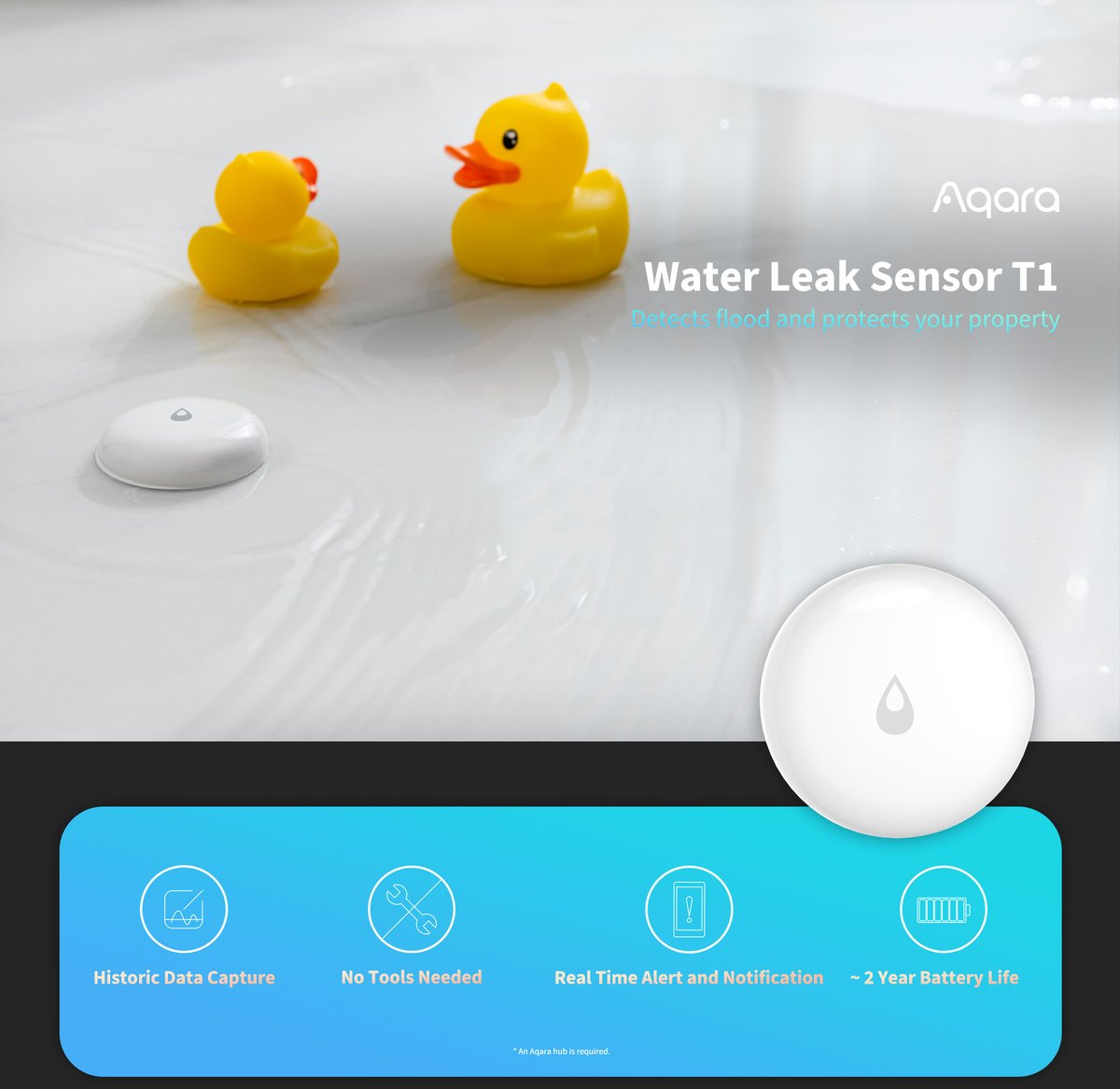
Price: From S (HomeSmart Singapore) Protocol: Zigbee 3.0 Battery: CR2032 coin cell, 2+ years Hub Required: Yes (Aqara Hub M3, M2, M1S, or others) Siren: No (relies on hub siren and phone notifications) IP Rating: IP67
If you are already running an Aqara smart home — and many Singapore homeowners are — the Water Leak Sensor T1 is the obvious choice. It triggers when the water level reaches just 0.5mm, and it is IP67 rated, meaning it will keep working even when fully submerged.
The T1 works with Apple Home (including Critical Alerts, which bypass Do Not Disturb), Samsung SmartThings, and Alexa. Through an Aqara Hub M3, you can also set up automations — for example, triggering a siren on the hub, turning on all lights, and sending you a push notification the instant water is detected.
The sensor itself does not have a built-in siren, so you are relying on the hub and your phone for alerts. That said, the Critical Alerts feature on iPhone is genuinely useful — it will sound an alarm even if your phone is on silent, which could save your flat at 3am.
You can pick one up from HomeSmart Singapore for around S, or from Aqara Singapore (PFE Tech) for S–33 depending on ongoing promotions.
3. Shelly Flood Gen4 — Best for Power Users and Home Assistant
Price: ~S (US.99) Protocol: Wi-Fi, Zigbee, Bluetooth, and Matter Battery: 1x CR123A, ~2 years Siren: Yes (100 dB, three alarm modes) IP Rating: IP44 Cable Detection: Yes (2m cable included, extendable to 150m)
The Shelly Flood Gen4 is the Swiss Army knife of leak detectors. During setup, you choose your protocol — Wi-Fi, Zigbee, Bluetooth, or Matter — so it fits into literally any smart home ecosystem. For Home Assistant users, it is a dream.
The killer feature is the 2-metre sensing cable. Instead of placing a puck under your sink and hoping the water reaches it, you can snake the cable along the floor behind your washing machine, under your kitchen cabinets, or along the base of your bathroom wall. Additional 2-metre extension cables cost about S each, and you can daisy-chain them up to 150 metres — enough to wire up an entire shophouse.
The built-in 100 dB siren has three modes: Intense, Normal, and Economic. The Economic mode is designed for vacation homes or rarely-visited spaces, conserving battery while still catching leaks.
The Shelly Flood Gen4 is available through Shelly’s Asia store or Amazon. It is not stocked by local Singapore retailers yet, but shipping from the Asia store is straightforward.
4. SwitchBot Water Leak Detector — Best No-Hub Wi-Fi Option
Price: ~S (US.99) Protocol: Wi-Fi (2.4 GHz) + Bluetooth Battery: 2x AAA, ~24 months Hub Required: No Siren: Yes (100 dB, adjustable) IP Rating: IP67
If you want leak detection without buying into any smart home ecosystem, the SwitchBot Water Leak Detector is the one to get. It connects directly to your 2.4 GHz Wi-Fi — no hub, no bridge, no subscription. Just pair it in the SwitchBot app and place it where you need it.
The 3-in-1 detection handles drips, immersion, and water-level changes, triggering at just 0.5mm of water. The adjustable 100 dB siren is loud enough to be heard two rooms away, and it works locally even without internet.
It also integrates with Alexa, Google Assistant, Siri Shortcuts, IFTTT, and SmartThings, so you can build automations without being locked into the SwitchBot ecosystem.
The trade-off is Wi-Fi battery drain — you will get about two years per set of AAA batteries, which is decent but not exceptional. In an HDB where the Wi-Fi router is three walls away, the sensor may also occasionally disconnect. For the best reliability, place the sensor within reasonable range of your router.
5. Eve Water Guard — Best Sensing Cable for Apple Home
Price: ~S (US.95) Protocol: Thread + Bluetooth (HomeKit only; Matter firmware update available) Power: Mains-powered (wall outlet) Hub Required: Thread Border Router (Apple TV 4K, HomePod) Siren: Yes (100 dB) Cable Detection: Yes (2m cable included, extendable to 150m)
The Eve Water Guard is the premium option, and it earns its price tag in one critical way: it is mains-powered. No batteries to die, no silent failures. Plug it into a wall outlet, snake the 2-metre sensing cable where you need it, and forget about it until it saves your flat.
As a Thread router node, the Eve Water Guard also strengthens your Thread mesh network — every one you add makes your other Thread devices more reliable. On Thread, leak detection is virtually instant with no lag between detection and alarm.
The downside? It has historically been Apple HomeKit-only, though Eve has been rolling out Matter firmware updates across their product line. Check the Eve app for the latest firmware status. It also requires a wall outlet, which limits placement options — you cannot stick it behind a toilet where there is no plug.
At around S, it is the most expensive option on this list, but for a mains-powered, cable-sensing, Thread-routing leak detector, it is genuinely excellent.
Where to Place Water Leak Sensors in Your Singapore Home
Here is my recommended placement strategy for a typical 4-room HDB flat. You need at minimum four sensors:
Kitchen (2 sensors)
- Under the kitchen sink — This is the number one leak source in any home. The flexi hose connecting your tap to the water supply is a ticking time bomb, especially if it is more than five years old. Place the sensor directly below the hose connections.
- Behind the washing machine — Inlet hoses and drain connections are common failure points. If your washer is in the kitchen (as in many older HDB layouts), get a sensor behind it.
Bathrooms (1 per bathroom)
- Next to the toilet base — Wax ring failures and supply line leaks are common in older HDB flats. Place the sensor on the floor next to the toilet, on the side closest to the wall where the supply line connects.
Utility Area (1 sensor)
- Under or near the water heater — Instant water heaters are less risky, but storage heaters can develop slow leaks from the tank. If your water heater is wall-mounted, place the sensor directly below it.
Bonus Placements
- Aircon drain pan — If your indoor aircon unit’s drain pan overflows (often due to a clogged condensate drain), it can drip onto walls and ceilings. A sensor in the drain pan catches this early.
- Near the main water inlet — Usually located in the riser or metre box area, a sensor here catches supply-side leaks before they reach your flat.
Quick Comparison Table
| Sensor | Price (est. SGD) | Protocol | Hub Needed | Siren | Cable Detect | Battery Life |
|---|---|---|---|---|---|---|
| IKEA KLIPPBOK | ~S–15 | Matter/Thread | Thread BR | Yes | No | ~2 years |
| Aqara Water Leak T1 | ~S–33 | Zigbee 3.0 | Aqara Hub | No | No | 2+ years |
| Shelly Flood Gen4 | ~S | Wi-Fi/Zigbee/Matter | Optional | Yes (100 dB) | Yes (2m) | ~2 years |
| SwitchBot Leak Detector | ~S | Wi-Fi/BT | No | Yes (100 dB) | Optional | ~2 years |
| Eve Water Guard | ~S | Thread/BT | Apple TV/HomePod | Yes (100 dB) | Yes (2m) | Mains-powered |
The Bottom Line
If I were setting up water leak protection in a Singapore HDB today, here is exactly what I would do:
Budget setup (under S): Four Aqara Water Leak Sensor T1 units from HomeSmart Singapore at S each, paired with an Aqara Hub M3 you probably already own. Kitchen sink, washing machine, bathroom, water heater. Total: ~S.
No-hub setup (under S): Four SwitchBot Water Leak Detectors at ~S each. No hub needed, just Wi-Fi. Place and forget.
Premium Thread setup (under S): Two Eve Water Guards (mains-powered with cable detection) for the kitchen and laundry area, plus two IKEA KLIPPBOK sensors for the bathrooms. Mix of cable and point detection, all on Thread, no batteries to worry about in the highest-risk areas.
Water leak sensors are the most boring smart home purchase you will ever make. They sit on the floor, they do nothing, and you never think about them — until one night your flexi hose gives way, and instead of waking up to a flooded kitchen and a S,000 repair bill, you get a phone alert at 3am and shut off the water valve in thirty seconds.
That is a pretty good return on a S sensor.