Here’s a scenario every HDB dweller knows: the doorbell buzzes (or someone just knocks, because who wired a doorbell), and you shuffle over to squint through a 14mm glass peephole that shows a fisheye smudge of the corridor. If it’s after 9pm, you see basically nothing. That little optical peephole your BTO came with is 1970s technology bolted onto a 2026 door — and it’s the single easiest smart-home upgrade most Singaporeans still haven’t made.
The fix isn’t necessarily a full video doorbell. For a lot of HDB and condo layouts, a digital door viewer — a camera that slots straight into your existing peephole hole with a touchscreen on the inside of the door — is the smarter, cheaper, and more landlord-friendly choice. But the lines have blurred: peephole-style doorbells like the Aqara G4 and the monitor-equipped SwitchBot now overlap with the classic Eques-style viewers. So let’s sort out what actually belongs on your door.
Why a peephole camera, and not just any video doorbell
The core constraint in an HDB is drilling. Your flat’s main door is yours, but the common corridor wall beside it is HDB common property, and you’re not supposed to be drilling anchors into it or running cabling across it. That rules out a big chunk of the wall-mounted video doorbell market straight away — anything that assumes a nice bit of exterior wall or a doorframe gap to screw a baseplate into.
A peephole camera sidesteps all of that. It uses the hole that’s already punched through your door — no new holes, no cabling, fully reversible when you move out or hand back a rental. That’s why the “digital door viewer” became a Singapore locksmith staple long before Matter was a word. Fire-rated HDB main doors ship with a factory peephole, and most digital viewers are built to fit doors roughly 35mm to 110mm thick with a standard peephole bore, which covers virtually every HDB and condo door out there.
The second reason is the corridor itself. HDB common corridors are dim — often a single fluorescent tube twenty feet away — so infrared night vision isn’t a luxury here, it’s the whole point. An optical peephole is useless at night; a decent digital viewer will show you a clear greyscale image of whoever’s standing there at 2am.
If you want the full doorbell-plus-lock-plus-alarm picture, we’ve covered the wider category in our no-drill smart doorbell buyer’s guide. This piece is specifically about the peephole slot.
The classic: Eques Veiu and the “no-app” digital door viewer
If you walk into any HDB locksmith or digital-lock shop, the digital door viewer they’ll show you is almost certainly an Eques Veiu or one of its cousins (the Veiu Mini, the S1 Pro, the R-series). This is the category-defining product for a reason.
The concept is beautifully simple: the outdoor half is a slim camera plate that replaces your peephole glass, and the indoor half is a touchscreen panel that sits on the inside of your door. Someone presses the button (or trips the motion sensor) and your indoor screen lights up with a live view. You can see and — on two-way-audio models — talk to whoever’s there without opening the door, and crucially without touching your phone.
That last part is the Eques’s real selling point. In a multi-generational HDB household — which is most of them — the person answering the door is often a parent or grandparent who doesn’t want to fumble with an app. A physical screen on the door that Just Works is genuinely more useful for them than any amount of cloud AI. The Veiu series gives you a roughly 160°–180° wide-angle view, infrared night vision, motion-triggered snapshots, and phone alerts when you do want them, all running off a rechargeable internal battery with no wiring and no doorbell transformer required.
Pricing in Singapore runs from around S$249 up to S$319 depending on the model and screen size, typically installed by the shop you buy it from (installation is a five-minute job — unscrew the old peephole, sandwich the new unit through the hole, done). Availability is excellent: this is a mature product sold by essentially every digital-lock retailer on the island.
The honest limitations: image quality tops out lower than the app-first competition (many models are still 720p-class on the recording side), the companion apps are clunky and cloud accounts can feel sketchy, and there’s no Matter, HomeKit, Alexa, or Google integration whatsoever. This is a self-contained security gadget, not a smart-home citizen. If you never want it to talk to your Aqara or Apple Home setup, that’s fine — even freeing. If you do, look elsewhere.
The smart-home pick: Aqara Video Doorbell G4
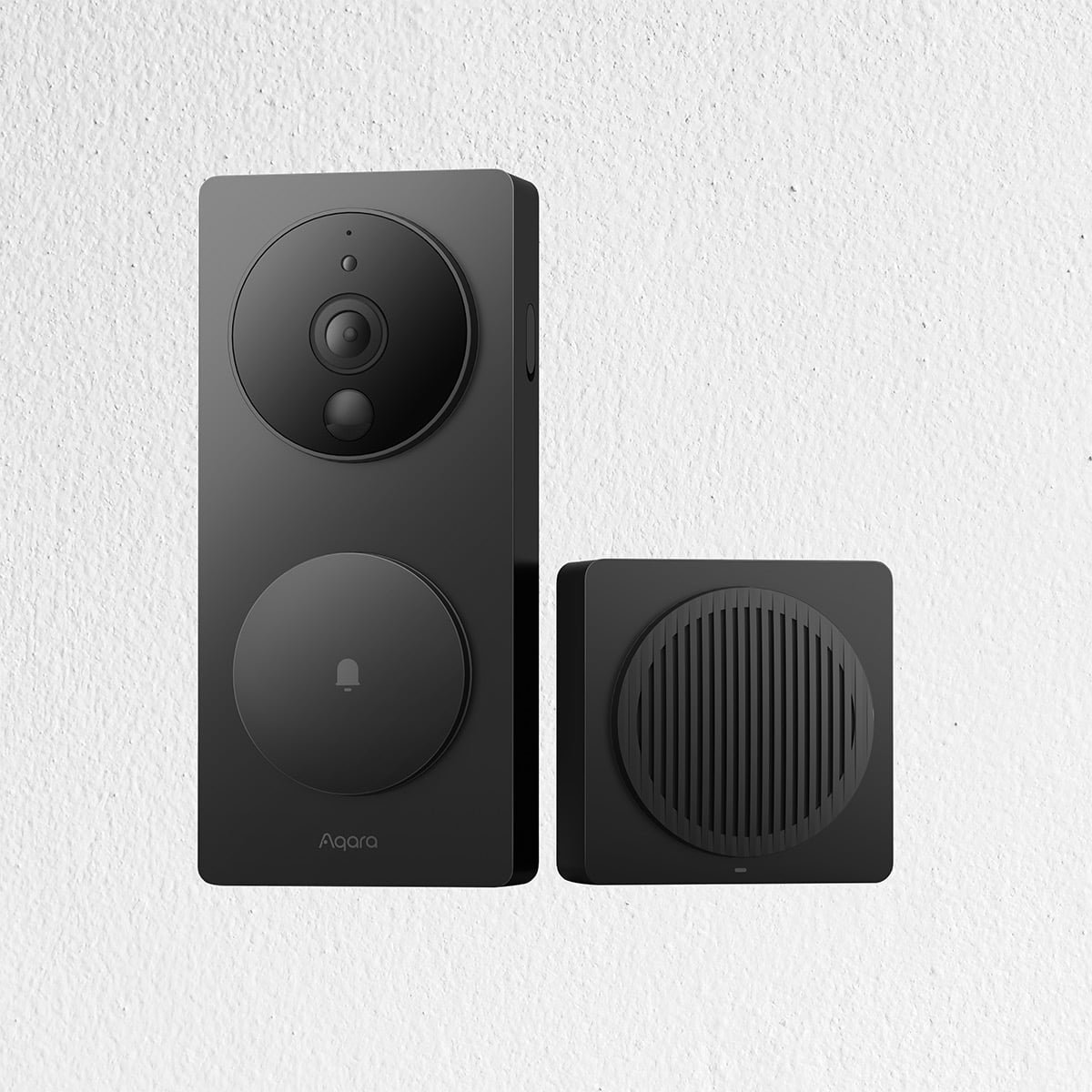
The Aqara Video Doorbell G4 is the device that dragged the peephole camera into the modern ecosystem. It’s technically a video doorbell, but its slim, battery-powered outdoor unit is small enough to mount on the door itself — and third-party no-drill peephole mounts exist specifically to fit it into an existing peephole hole, which is exactly the HDB-friendly trick you want.
What makes the G4 special is that it’s the only battery-powered doorbell that supports Apple HomeKit Secure Video, and it also streams to Google and Alexa displays. It does on-device facial recognition — so it can announce “Ah Ma is home” and trigger a scene — and Aqara throws in 7 days of rolling cloud storage for free, with no subscription, which is rare and very welcome. The included chime repeater doubles as a Wi-Fi extender with a loud 95dB speaker and a USB-C port. Specs are a 1080p sensor, a 162° wide-angle lens, and IR night vision, per Aqara’s official listing and TechRadar’s review.
Two caveats you must know before buying. First, the G4 is not a Matter device — it lives in Apple Home / Google / Alexa via Aqara’s own cloud, not the Matter standard. Cameras only entered Matter with version 1.5 and the ecosystem is barely off the ground, so this isn’t unique to Aqara, but don’t buy it expecting native Matter. Second, and more practically, that ultra-wide 162° lens is oriented landscape and sits high — TechRadar’s reviewer found it misses parcels left on the doormat directly below. In an HDB where couriers dump your Shopee haul on the floor outside, that’s a real blind spot.
Price in Singapore is around S$339–S$369 through local Aqara retailers like HomeSmart and pfetech’s Aqara store. It runs on six AA batteries (a few months per set) or can be hardwired. If you’re already deep in Aqara — a hub, some FP-series presence sensors, a U-series lock — the G4 is the obvious pick because it slots into automations you already have.
The value play: SwitchBot Video Doorbell with monitor
The newest entrant worth your attention is the SwitchBot Video Doorbell, and it’s a clever hybrid of the two philosophies above: it’s an app-first smart doorbell that also ships with a 4.3-inch portable indoor monitor, so you get the Eques-style “answer the door without a phone” experience plus proper ecosystem support.
On paper it out-specs the Aqara: 2K (Full HD) video, a 165° ultra-wide lens with a 16:9 head-to-toe aspect ratio that actually captures packages on the floor, a huge 5,000mAh battery SwitchBot rates for up to 19 months, and an IP65 weather rating. Storage is refreshingly un-greedy — the bundled monitor takes a microSD card up to 512GB (a 4GB card is included) with no subscription required, and there’s optional cloud if you want it. It works with Alexa, Google Home, and Home Assistant, and while the camera stream itself isn’t Matter (again, Matter 1.5 cameras aren’t real-world ready yet), the doorbell can act as a Matter bridge to pull one SwitchBot device into a Matter setup. PCWorld liked the included-monitor value; Gizmodo was harsher about who it’s actually for.
The catch for us: SwitchBot doesn’t have an official Singapore retail channel for this yet, so you’re looking at importing it via Lazada, Shopee, or Amazon at roughly US$150 (around S$200 landed). That’s still the cheapest way to get a peephole-monitor combo with modern specs — but factor in warranty and support being harder than buying an Aqara or Eques locally. And note it’s a face-mounted doorbell by design; peephole-slot mounting takes a third-party bracket, same as the G4.
Installation and HDB compliance: the fine print
Before you buy, five things to check on your specific door:
- Door thickness. Most digital viewers handle roughly 35–110mm. HDB fire-rated main doors usually sit comfortably in that range, but if you’ve had a thick laminate or a bulky metal-clad door installed, measure first — the sandwich bracket has to reach through.
- Existing peephole bore. The standard peephole hole is around 14–26mm. Self-contained viewers like the Eques are built to fit it directly; the Aqara G4 and SwitchBot are face-mount doorbells that need a third-party peephole bracket to use the hole without drilling. Confirm the bracket matches your bore before ordering.
- Don’t touch the corridor wall. The whole appeal here is that everything mounts to your door, not HDB common property. If a shop suggests drilling the corridor wall to mount an outdoor unit, that’s the wrong product for a flat — walk away.
- Gate clearance. If you keep your metal grille gate closed, check that the outdoor camera plate doesn’t foul the gate when it swings, and that the lens can still see past the grille. Slim peephole plates win here; chunkier doorbells can be awkward.
- Fire door integrity. You’re reusing an existing hole, so you’re not compromising the fire rating — but avoid drilling new holes in a fire-rated door. Another reason the peephole slot is the right approach.
Actual fitting is genuinely a five-minute, tool-light job: remove the old optical peephole, pass the camera stem through, and screw the indoor unit on from the inside. Local shops bundle installation; the imported SwitchBot you’ll likely DIY.
Which one should go on your door?
Here’s how I’d actually decide, HDB-style:
- You want the simplest thing that works, for a household that includes elderly parents: get the Eques Veiu. Buy it from a local shop, let them install it, enjoy the physical touchscreen and never think about it again. No app drama, no ecosystem, no subscription. ~S$249–319.
- You’re already an Apple Home or Aqara household: get the Aqara G4. The HomeKit Secure Video support, on-device face recognition, and free 7-day storage are genuinely best-in-class, and it plugs into automations you already run. Just add a peephole mount and accept the doormat blind spot. ~S$339–369 locally.
- You want the best specs per dollar and don’t mind importing: the SwitchBot Video Doorbell with its 2K head-to-toe view, 512GB local storage, and included monitor is the value champion at ~S$200 — as long as you’re comfortable buying grey-market and living without a Singapore warranty.
Whichever you pick, a peephole camera pairs naturally with the rest of a no-drill HDB security stack — most usefully a no-subscription smart alarm system that ties motion at the door into the rest of the flat without locking you into a monthly fee. For landed homes and larger condos where you can drill and want to cover the whole perimeter, step up to proper outdoor security cameras instead.
The bottom line: that dumb optical peephole is the lowest-hanging fruit in your entire flat. For a couple hundred dollars and zero drilling, you can see and record everyone who comes to your door, day or night, and — if you go with Aqara — have your home greet you by name when you get back. In 2026, there’s no reason to keep squinting.