Singapore has a strange blind spot when it comes to smart locks. Walk into any digital lock showroom in Balestier or Tampines and you’ll be shown a wall of push-pull mortise units — Philips, Kaadas, Hafele, Zigbang, igloohome — priced between S$700 and S$1,500, installed next week, fingerprint reader on the handle, done. Nobody will mention Matter. Nobody will mention Thread. And when you get home and try to add that shiny new lock to Apple Home or Google Home, you’ll discover it lives in its own app, forever, alone.
Meanwhile the global smart home press spends its time on retrofit deadbolts that physically cannot fit an HDB fire door.
So this is the guide that sits in the gap: which locks you can actually buy and install in Singapore in 2026, which of them genuinely talk to your smart home, and where the compliance landmines are buried.
First, the rule that overrides every other consideration
Before you fall in love with any lock: your HDB main door is almost certainly fire-rated, and since 1 March 2024 any digital lock installed on a fire-rated door must itself be fire-rated, with a valid Certificate of Conformity to SS 332 or EN 1634-1. That rule is still being enforced in 2026, and it is not a formality — a non-compliant install can fail inspection and leave you replacing both the lock and the door.
Practically, this means three things:
- The lock must carry fire-rated certification, and the installer should be able to produce the CoC. Ask for it. A shop that gets cagey about paperwork is telling you something.
- There must be a mechanical override — a physical key cylinder. Every lock in this guide has one. Any lock that doesn’t, walk away.
- Installation must not compromise the door’s rating. That means no enthusiastic freehand drilling, which in turn means this is genuinely not a DIY job for the main door.
You do not need formal HDB approval for a straight lock replacement — it’s treated as routine maintenance. Renting? Get it in writing from your landlord and agree upfront that you’ll restore the original lock at end of lease. Most landlords say yes, because a digital lock is a genuine upgrade to their asset.
The metal gate is a different story — it’s not fire-rated, it’s not structural, and the rules are far looser. Which is why, as you’ll see, the gate is where a lot of Singapore smart lock strategies quietly begin.
The two species of lock, and why the difference matters
Singapore’s lock market has effectively split into two categories that barely acknowledge each other.
Digital locks are the Korean-lineage push-pull mortise units that dominate local showrooms. Big outer panel, integrated handle, fingerprint sensor, PIN keypad, RFID card. They’re built for exactly the kind of door you have. They’re sold with installation included. And their “smart” features almost always terminate at a proprietary app plus, at best, a Wi-Fi gateway. No Matter. No Thread. No Apple Home.
Smart locks in the international sense are built protocol-first — Matter over Thread, Apple Home Key, native support in Apple Home, Google Home, Alexa and SmartThings without a translation layer. Historically the catch was form factor: most were retrofit deadbolts designed for American doors.
The interesting development of the last two years is that Aqara has been steadily building locks in both shapes, which is why they dominate the recommendations below. It’s not brand loyalty — it’s that almost nobody else is shipping a genuinely Matter-native lock in a form factor that fits a Singapore door.
If you’re fuzzy on why Thread specifically matters for a battery device on a metal-heavy door, our Thread vs Matter explainer covers the mesh mechanics.
The flagship: Aqara Smart Lock U400
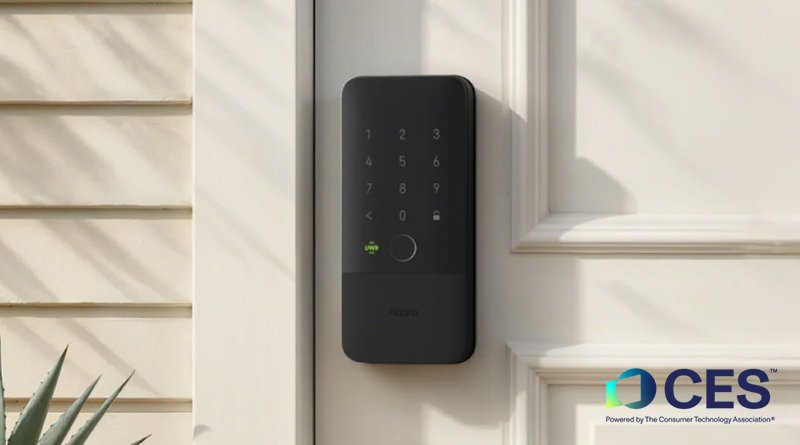
The U400 launched at CES 2026 and is the most genuinely new thing to happen to smart locks in years. Singapore was in the first wave of launch markets, alongside the US, Canada, Australia and New Zealand — which basically never happens, so enjoy it.
The headline is ultra-wideband. Where existing Apple Home Key locks require you to tap your iPhone or Apple Watch against the reader, the U400 uses UWB time-of-flight distance measurement plus angle-of-arrival to work out not just how far you are but which direction you’re approaching from. Walk up to your door and it unlocks. Walk past it on the way to the lift lobby and it doesn’t. That directional awareness is the part everyone underestimates — proximity-only unlocking in an HDB corridor, where neighbours and delivery riders pass your door constantly, would be a security disaster. Aqara also built in relay-attack protections including scrambled timestamp sequencing.
Beyond UWB it’s a fully loaded Matter-over-Thread deadbolt: NFC, fingerprint, one-time and recurring passcodes, remote unlock, Siri and Alexa voice control, physical key backup, built-in gyroscope for auto-lock, IP65 weather resistance, and a rechargeable lithium-ion battery rated at roughly six months per charge. Samsung Wallet support was slated for Q1 2026, which would turn a Galaxy phone into a digital key too.
Because it’s Matter-certified over Thread, it works natively with Apple Home, Google Home, Alexa and SmartThings without an Aqara hub. You still want a Thread border router in the flat for reliable remote access — a HomePod mini, Apple TV, or an Aqara hub will do it.
Singapore pricing runs S$469 to S$849 through HomeSmart depending on colour and whether you take the no-install, wooden-door or gate installation option, with an Aqara Hub M100 bundled in. For reference the US MSRP is US$269.99, so the local pricing is fair once installation is in the mix.
Reviewers have been broadly positive, with the consistent caveat that the hands-free magic is meaningfully better on Apple hardware than anywhere else. If your household is split between iPhone and Android, calibrate expectations.
Buy it if: you’re an Apple household, you want the best keyless experience available in Singapore right now, and the budget is there.
The value pick: Aqara Smart Lock U300
The U300 is the one I’d actually recommend to most people, and it’s a lever lock — which matters enormously in Singapore, because lever handles are what’s on most bedroom, study, storeroom and back doors.
It’s Matter over Thread, so it slots into Apple Home, Google Home and Alexa natively. Unlock via fingerprint, keypad, Apple Home Key or NFC, with two mechanical keys for emergencies. IPX4 rating, an operating range of −30°C to 55°C (comfortably beyond anything Singapore will do to it), and — the genuinely impressive bit — roughly ten months on four AA batteries. That’s Thread’s low-power design doing its job. It’s also a single-bore install, which makes it far less invasive than a mortise replacement.
Local pricing is S$359–479 depending on install option and colour, with a 24-month onsite warranty.
The honest limitation: a lever lock is not the right answer for your HDB main entrance, where you want a mortise unit. Think of the U300 as the lock that makes your second and third doors smart — a home office you want logged access to, a storeroom, a rental room, a granny flat. Used that way it’s excellent value.
The Singapore-shaped one: Aqara Smart Lock D200i
The D200i is Aqara’s answer to the local showroom wall: a proper push-pull mortise lock in the Korean idiom, with a fully automatic lockset and 3D facial recognition that unlocks in under a second. Fifty face profiles, fifty PIN codes, twenty-five NFC devices, plus temporary passcodes and mechanical keys. Auto-lock on door close, tamper alarms, electromagnetic shielding, anti-snoop PIN entry, USB-C charging with about four months per charge.
Here’s the important asterisk, and local retailers gloss over it: the D200i is Zigbee 3.0 and Bluetooth, not Matter over Thread. It supports Apple Home Key for tap-to-unlock, but to get it into Apple Home or Google Home as a controllable accessory you need an Aqara hub bridging it into Matter. That’s a perfectly fine architecture — it’s how most people run Aqara anyway, and our Aqara Hub M3 comparison walks through the options — but it is a hub dependency, and you should know you’re buying one.
At S$1,099 from HomeSmart with installation on standard wooden doors and a 24-month local warranty, it’s priced right in the Philips EasyKey 9300 / Kaadas K9 bracket. The difference is that at the end of the install you have a lock that participates in a real automation ecosystem rather than one that phones home to a vendor app.
The offline-first alternative: igloohome Mortise 2
I want to be fair to the local incumbent, because igloohome is genuinely good at something the Matter crowd is bad at.
The Mortise 2 is S$574, Korean-manufactured, and works entirely offline by default. Its algoPIN technology generates time-bound PIN codes algorithmically — you can issue a guest code from Bangkok without the lock ever having touched the internet. There’s Airbnb account integration that auto-issues codes per booking. Access is via PIN, Bluetooth, RFID tag and physical key. A separate Bridge accessory (S$109) adds remote status and unlock.
There is no Matter support, and igloohome hasn’t announced any. It integrates with Alexa and Siri Shortcuts and stops there.
But if you rent out a room, run a short-let, manage a property from overseas, or simply distrust putting your front door on a Wi-Fi network, offline-by-design is a legitimate security posture rather than a limitation. Just buy it with clear eyes: this is a very good lock and a non-participant in your smart home.
What about Philips, Kaadas and the rest of the showroom?
The Philips EasyKey 9300 sits around S$800–950 in 2026 and is a competent flagship push-pull with six access modes — fingerprint, PIN, RFID, mechanical key, Bluetooth and Wi-Fi — and a built-in Wi-Fi gateway for remote passcode management. Kaadas’ K9-5W lands in similar territory with 100 fingerprints and 100 RFID cards.
Both are solid hardware. Neither is Matter. Both will live in a vendor app for the rest of their service life, which for a lock is fifteen-plus years. If you have zero interest in ever automating your door — no “unlock and turn on the hallway lights when I get home”, no presence-triggered anything, no unified app — they’re perfectly reasonable purchases and the local support networks are excellent.
If you’re reading a smart home magazine, though, you probably do care. Buy the protocol, not just the panel.
The gate: Singapore’s actual secret weapon
Almost every guide written outside Singapore ignores the metal gate, which is a shame, because it’s the easiest smart lock win in the country. It’s not fire-rated, so the SS 332 compliance question evaporates. It’s usually the door you actually use when you’re home. And gate locks are cheaper than main door locks.
Aqara’s U100 gate lock kit runs S$699, with Apple Home Key support, fingerprint, PIN, NFC card, Zigbee 3.0 and Bluetooth 5.0. Compatibility depends on your specific gate — HomeSmart explicitly notes it doesn’t fit all of them and offers a dedicated metal gate lock as an alternative — so this is one to confirm with photos and measurements before ordering.
One trap worth flagging: the Aqara U50, at S$239–369, looks like a bargain gate lock and isn’t one. Aqara is explicit that it’s not suitable for metal gates. It’s a main-door lock — Apple Home Key, keypad, key, NFC card, USB-C emergency power, six months on four AAs, BHMA Level 3, Zigbee and Bluetooth with a hub needed for full integration. Good lock, wrong door for the job people keep buying it for.
How to actually choose
Strip away the marketing and it’s four questions.
Which door? Main door means fire-rated mortise — D200i, Philips, Kaadas, igloohome. Gate means U100 or a dedicated gate unit. Internal doors mean U300. Getting this wrong is the single most expensive mistake in this category.
Apple or Android? Apple Home Key and UWB are the strongest arguments for the U400 and they’re materially better on Apple hardware. Android households get less from the premium and should weigh the U300 or D200i harder.
Matter-native or hub-bridged? U400 and U300 are Matter over Thread and need no Aqara hub. D200i, U100 and U50 are Zigbee and need one. Neither is wrong — hub-bridged is arguably more robust for local control — but budget for the hub if you’re going that route.
Online or offline? If the lock is for guests, tenants or a property you don’t live in, igloohome’s offline algoPIN model is a real and defensible choice.
For a fuller walkthrough of door types, backset measurements and installation gotchas, HomeSmart’s guide to choosing a smart door lock in Singapore is the most Singapore-specific reference around, and if you’re building out the rest of the entryway our guides to smart doorbells and smart peephole cameras pair naturally with any of these locks.
The verdict
If you want one recommendation: Aqara U400 on the main door if you’re an Apple household and the budget stretches; Aqara D200i if you want a familiar push-pull mortise that still joins your smart home; igloohome Mortise 2 if the door is for other people. Add a U300 on internal doors as a cheap, near-invisible upgrade, and don’t sleep on the gate.
And whatever you buy, get the fire-rating certificate in your hands before the installer picks up a drill. The lock you regret isn’t the one with the wrong protocol — it’s the one that fails an inspection two years from now.