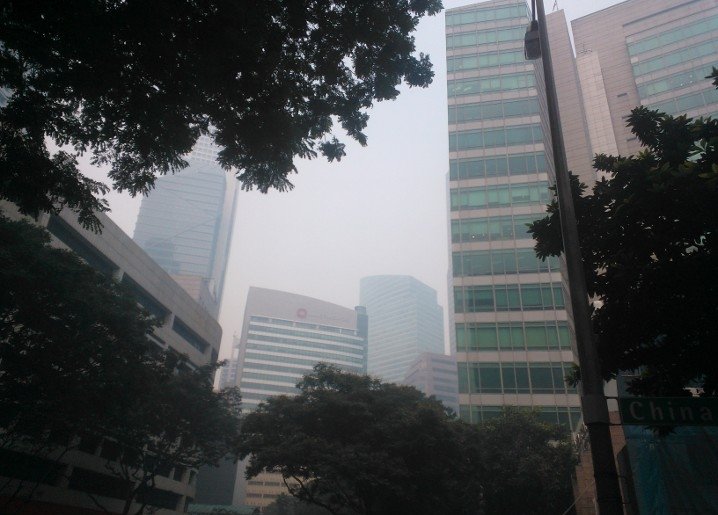
Singapore spent most of August 2026 sitting in the “moderate” band — 24-hour PSI readings hovering somewhere in the 70s and 80s in the Central region, just high enough to notice a faint smell in the corridor and not high enough for anyone to do anything about it.
That is exactly the part that should get your attention, because the Singapore Institute of International Affairs has already issued a rare “Red” outlook for 2026 — only the second time since it began publishing annual haze forecasts in 2019 — and it named August and September as the peak danger window. NEA’s Haze Task Force is on standby, ready to activate its action plans if readings cross into unhealthy territory. We are, in other words, in the first act.
If you own an air purifier, here is the uncomfortable truth: leaving it on “auto” is the smart-home equivalent of leaving your front door unlocked and hoping. Auto mode is reactive. It waits until the haze is already in your living room, then spins up. In an HDB flat with a permanently ajar kitchen window and a service yard that vents straight into the common corridor, “already in your living room” is far too late.
The fix is not a better purifier. It’s a purifier that takes orders from data it can’t sense on its own.
Why “auto mode” fails during a haze
Every smart purifier worth buying has a particulate sensor and an auto mode that maps sensor reading to fan speed. That closed loop is genuinely good at handling cooking smoke, a dusty renovation next door, or the general grime of living near the PIE.
It is bad at haze for one structural reason: the sensor is inside and the haze is outside. By the time your bedroom’s PM2.5 sensor sees a number worth reacting to, transboundary smoke has already crossed your window line and is being redistributed by your ceiling fan. You’re now removing particulate that you could have kept out.
The other failure is subtler. Most auto modes are tuned to be polite — they ramp gently, because nobody wants a purifier that screams at 3am. During a genuine haze episode you want the opposite: a hard pre-emptive purge before the outdoor numbers spike, then a sustained medium speed, then a return to quiet.
Outdoor PSI and PM2.5 data gives you the leading indicator. And in Singapore, that data is free, official, and hourly.
Know your numbers: PSI is not PM2.5
Before you automate anything, get the two scales straight, because they behave very differently and people conflate them constantly.
24-hour PSI is the headline number NEA publishes and the one the news reports. Its bands:
| PSI (24-hr) | Band |
|---|---|
| 0–50 | Good |
| 51–100 | Moderate |
| 101–200 | Unhealthy |
| 201–300 | Very unhealthy |
| Above 300 | Hazardous |
1-hour PM2.5 concentration is the fast-moving one, and NEA bands it separately: 55 µg/m³ and below is “normal,” 56–150 is “elevated,” 151–250 is “high,” and anything above 250 is “very high.”
Here’s the practical point. Because PSI is a 24-hour rolling average, it lags badly. A sharp evening smoke plume can push 1-hour PM2.5 into “elevated” while the 24-hour PSI barely twitches, because yesterday’s clean air is still dragging the average down. If you build your automation on 24-hour PSI, you will consistently react hours late.
Automate on 1-hour PM2.5. Use 24-hour PSI for context and for deciding whether to keep windows shut all day. This is the single most important design decision in this whole article.
Getting NEA data into your smart home
Singapore’s open data programme makes this genuinely easy, and there’s no API key required for basic use.
The real-time PSI endpoint is https://api.data.gov.sg/v1/environment/psi — still live and returning data as of writing. There is also a newer v2 endpoint at https://api-open.data.gov.sg/v2/real-time/api/psi. Both are published by NEA via data.gov.sg, update hourly, and break readings down by region: north, south, east, central and west. There’s a matching PM2.5 endpoint on the same pattern.
That regional breakdown matters more than people realise. Readings routinely diverge across the island depending on wind direction — as I write this the five regions are spread across 18 to 21 µg/m³, and during an actual episode that gap widens considerably. The difference between automating on a national figure and automating on your region is the difference between a purifier that runs when you need it and one that runs when Jurong needs it.
Home Assistant is by far the easiest place to consume this. There are community integrations — nea_sg_weather exposes per-region PM2.5 sensors pulled straight from the data.gov.sg API, and sgnea does nowcast data — but honestly you don’t even need them. A REST sensor in configuration.yaml does the job in a dozen lines:
rest:
  - resource: https://api.data.gov.sg/v1/environment/pm25
    scan_interval: 900
    sensor:
      - name: "PM2.5 Central"
        unit_of_measurement: "µg/m³"
        value_template: >
          {{ value_json.items[0].readings.pm25_one_hourly.central }}
Swap central for your region. Fifteen-minute polling is plenty — the source only refreshes hourly, and hammering a free government API is bad manners.
If you’re not on Home Assistant, this is where things get bleak. Apple Home, Google Home and Alexa have no native way to ingest NEA data. There is no PSI trigger. Your options are an iOS Shortcuts automation that hits the API and toggles a HomeKit scene, or accepting indoor-sensor-only automation. This is a recurring theme on this site: the moment you want to automate on something the big three platforms didn’t anticipate, you need a local brain. If you’ve been putting off that decision, our guide to Home Assistant hardware in Singapore covers what to buy — though be warned, the RAM crisis has made it an expensive year to start.
Which purifiers actually take orders
This is the part where a lot of “best air purifier” listicles fall apart, because cleaning performance and controllability are completely different axes. A purifier that scores brilliantly on CADR but only speaks to a proprietary cloud app is close to useless in an automation.
Sorted by how well they behave in a real smart home:
Native Matter — the good tier. SwitchBot’s Air Purifier and Air Purifier Table both gained native Matter support via firmware (V2.2-2.2 and later), and crucially they work standalone — no Hub 2 or Hub Mini required. Both use a three-layer H13 HEPA stack, run down to about 20dB, and the Table version claims 400 m³/h CADR. 9to5Mac covered the update when it landed. The catch for us: SwitchBot has no official Singapore storefront, so you’re buying through marketplace resellers at whatever price the week dictates.
Also in this tier: Airversa’s Purelle AP2, which was the first Thread-based Apple Home purifier, and the AiDot WELOV P200 Pro, which exposes its air quality sensor data to the Home app as well as its fan controls.
Worth knowing: Apple Home only gained proper air purifier device-type support in iOS 18. If you’re on an older HomePod or haven’t updated your controller, a Matter purifier will pair and then sit there looking useless. Check that first before you blame the hardware.
Bridged Matter — the pragmatic tier. IKEA’s STARKVIND is S$189 at IKEA Singapore, covers up to 20 m² depending on fan speed, and uses an EPA 12 particle filter rated around 99.5% on fine particles, with an optional gas filter you can stack on top. On its own it’s a dumb box with a dial. Paired with a DIRIGERA hub it becomes app-controllable, gets a PM2.5-driven auto mode, and — because DIRIGERA acts as a Matter bridge, a Thread border router and a Matter controller all at once — becomes visible to Apple Home, Google Home, Alexa and Home Assistant.
The 20 m² rating is the honest constraint here. That’s a bedroom, not an HDB living-dining. Buy two rather than expecting one to cover an open-plan 4-room.
Cloud-app tier. The Xiaomi Smart Air Purifier 4 line is the value pick in Singapore and is sold locally through Xiaomi’s own channels and mainstream retailers. Xiaomi rates the standard model at roughly 20 m² cleared in about ten minutes. It has no Matter support, and Mi Home is a cloud app — but there’s a well-trodden escape hatch: Home Assistant’s xiaomi_miio integration, which after a one-time token extraction talks to the unit entirely over your LAN. That’s a better end state than most Matter devices manage.
Levoit’s Core 400S sits in the same category with a worse escape hatch. VeSync app, Alexa and Google voice control, no native Matter, no native HomeKit. Home Assistant reaches it via the VeSync integration — cloud-dependent — and HomeKit only through a community Homebridge plugin. It cleans well. It just doesn’t integrate well.
The smart plug fallback. Tempting, and occasionally correct, but test one thing before you commit: cut power to your purifier at the wall, restore it, and see whether it resumes running at its previous speed or sits dark waiting for a button press. Many purifiers do the latter, which makes plug-based automation worthless. If yours resumes, a plug with energy monitoring is a legitimate budget path — and our smart plug guide covers which ones report power reliably enough to confirm the purifier actually started.
Your sensors, and the Aqara trap
Outdoor data tells you what’s coming. You still want indoor sensors to confirm the purifier is winning.
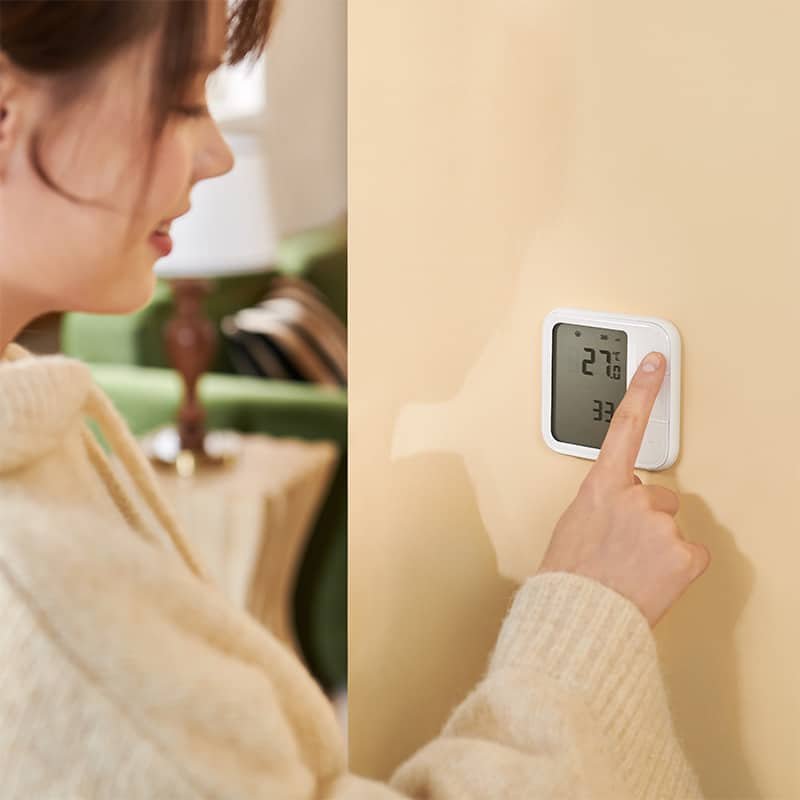
One correction worth making loudly, because it catches Aqara owners every haze season: the Aqara TVOC Air Quality Monitor does not measure PM2.5. It measures total volatile organic compounds, temperature and humidity. Those are real, useful metrics — TVOC is genuinely good at catching off-gassing from new furniture and cleaning products — but haze is particulate, and TVOC will not see it. Similarly, the Aqara Climate Sensor W100 is a temperature and humidity device. Excellent for the aircon automations in our IR blaster guide; blind to smoke.
For actual PM2.5 you need a particulate sensor. IKEA’s VINDSTYRKA runs about S$60 and reports PM2.5, TVOC, temperature and humidity on a small display, exposing all of it to the IKEA Home smart app — and onward through DIRIGERA to Matter. The cheaper VINDRIKTNING gives you a three-colour PM2.5 light and nothing else unless you solder a radio onto it, which is a fun Saturday but not a recommendation. For the wider field, see our smart air quality monitor comparison.
Matter, for its part, has been ready for this since Matter 1.2, which added both the Air Purifier and Air Quality Sensor device types along with PM1/PM2.5/PM10, CO2, NO2, VOC, CO, ozone, radon and formaldehyde reporting — plus consumable monitoring, so a certified purifier can tell your dashboard its HEPA and carbon filters are spent. The specification is not the bottleneck. Manufacturer implementation is.
Three automations worth building this week
1. The pre-emptive purge. When regional 1-hour PM2.5 crosses 56 µg/m³ (NEA’s “elevated” threshold), run every purifier at maximum for 20 minutes, then drop to medium and hold. You’re front-loading the cleaning while indoor air is still good, and buying yourself a clean baseline before the outdoor peak arrives.
2. The closed loop. Once outdoor PM2.5 falls back below 55, switch control authority to your indoor sensor: run high above 35 µg/m³ indoors, medium above 15, off below 12 — with a 15-minute minimum dwell time so it isn’t cycling every three minutes.
3. Seal the envelope. This one gets skipped and it’s arguably the highest-value automation of the three. On the “elevated” trigger, also close your motorised curtains or blinds (they cut infiltration around the window frame more than you’d guess), and if your aircon has a fresh-air intake mode, force it to recirculate. Our smart curtain guide covers the motors that handle this reliably. A push notification telling whoever’s home to shut the kitchen window is worth more than another 100 m³/h of CADR.
If you’re new to building this kind of conditional logic, HomeSmart’s Matter smart homes guide is a reasonable primer on what actually cross-talks today versus what’s marketing.
The honest limitations
Filters are the recurring cost nobody budgets for, and haze season is precisely when they load fastest. A purifier run hard through a bad September will eat a filter set in a fraction of its rated life. Buy replacements before the news cycle starts, because local stock evaporates within days of a PSI headline.
Sealing matters more than CADR. An HDB flat with gappy window frames and a permanently open service yard door will defeat any purifier you can buy. Weatherstripping is unglamorous and dramatically more cost-effective than upgrading from a 300 to a 400 m³/h unit.
And be realistic about coverage ratings. A 20 m² rating assumes a closed room. Open-plan living-dining, doors open, ceiling fan running — halve it.
The good news is that none of this requires much money. The NEA data is free, the API needs no key, and if you already run Home Assistant you can have the pre-emptive purge working in an evening. The purifier you own is probably fine. It just needs to stop waiting for the haze to find it.
PSI and PM2.5 bands per NEA. Prices checked late August 2026 and will move — haze-season pricing in particular is volatile.