If you’ve walked into a Singapore HDB flat built or renovated in the last three years, there’s a decent chance you’ve already met PRISM+. The 65-inch Google TV in the living room. The ceiling fan spinning above the dining table. The aircon in the master bedroom. Increasingly, the digital lock on the front door.
PRISM+ has done something genuinely impressive: it went direct-to-consumer, undercut the Japanese and Korean incumbents by a margin the company puts at up to 64% off list, put its own installers and aircon servicing crews on the road, and stitched the whole thing together with a single app. The company’s homepage now calls it “Singapore’s #1 Smart Home Brand,” and on volume alone, that’s not an outrageous claim.
But there’s a word doing a lot of heavy lifting in that slogan, and it’s not “Singapore.” It’s “smart.”
Because here’s the thing nobody puts on the product page: in 2026, when practically every other brand in this category has shipped Matter support, PRISM+ still hasn’t. Not on the aircon. Not on the fans. Not on the locks. If you’re building a smart home that you expect to still work in 2031, that omission should change how you shop.
What PRISM+ actually sells now
The range has grown fast. As of writing, PRISM+ sells Google TVs, gaming monitors, air conditioners, ceiling fans, smart locks, washing machines and dryers, refrigerators, vacuums, air purifiers, and soundbars. That’s a wider catalogue than most legacy brands maintain locally.
The pricing is the pitch. The Q43 Ultra QLED+ Google TV lists at S$849 and routinely sells around S$549 with a promo code stacked on. The Oasis smart ceiling fan starts at S$279 for the smart model and S$179 for the plain remote version, plus a flat S$50 installation fee per fan — against S$500 and up for a comparable DC-motor fan from an established name. It comes in 46-inch and 52-inch sizes, with a brushless DC motor, six speeds, and a 20W Osram LED with adjustable colour temperature. The Neo aircon is a 5-tick R32 inverter split that lands in the S$2,200–2,600 range for a system 2, with up to 10 years of comprehensive coverage if you keep servicing it through PRISM+ quarterly.
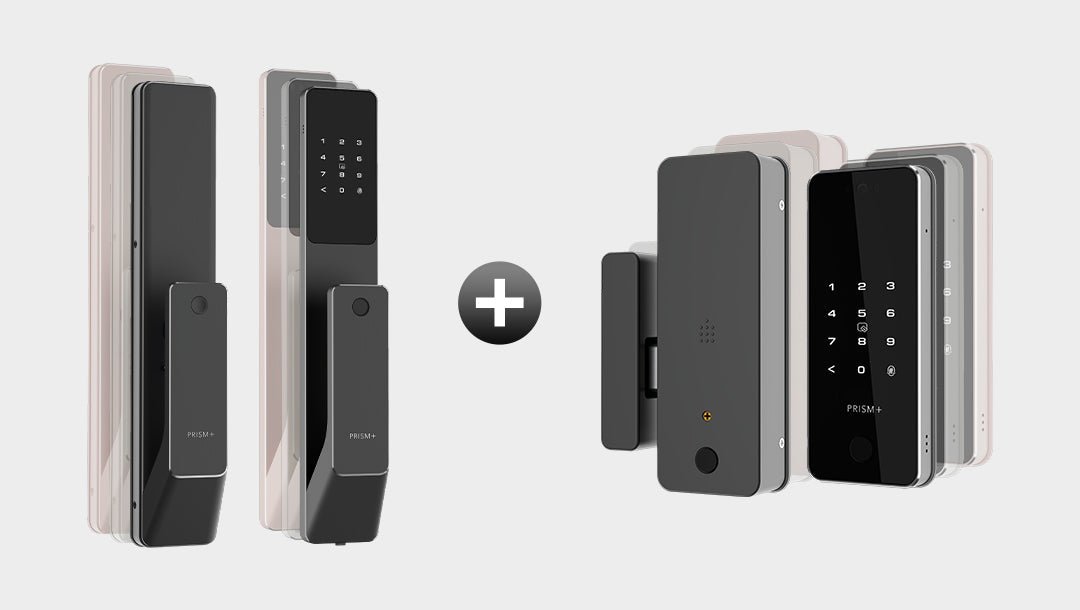
The smart locks are the newest and most interesting line. The Sentinel is marketed as Singapore’s slimmest at 11.5mm, starting around S$599 and climbing past S$800 for the Pro variant that adds 3D facial recognition to its seven standard unlock methods. The Spectre starts around S$699, or S$899 for a door-and-gate bundle, and tops out at nine unlock methods on the Ultra — palm vein, 3D face, fingerprint, keypad, card, sticker, remote, app and physical key, with the biometric two reserved for that top trim. Both run a 5,000mAh rechargeable pack rated for roughly 2,500 unlocks or six months of standby, and carry a three-year onsite warranty. PRISM+’s DuoSync feature fires the door and gate locks together, which is a real quality-of-life win in an HDB corridor and something surprisingly few brands bother to do properly.
On paper, that’s a complete smart home. So what’s the problem?
The problem: PRISM+ Connect is a walled garden with one gate
Everything PRISM+ makes that connects to Wi-Fi runs through the PRISM+ Connect app. That app is fine. It does schedules, routines, usage tracking, remote control, and it’ll even book your aircon servicing appointment. Reviews on the App Store and Play Store are broadly positive, though there’s a recurring seam of complaints about Wi-Fi pairing hanging during setup, gateway flakiness, and account sign-in failures that stretch on for weeks without a support reply.
The integration story is where it gets thin. PRISM+ Connect talks to Google Assistant. That’s it. No Amazon Alexa. No Apple Home. And — the one that actually matters going forward — no Matter.
I checked every current product page for the aircon, the fans, and the locks. Google Assistant pairing appears on the smart fan and the aircon. Matter, Apple Home, HomeKit and Alexa appear on none of them. The lock collection page mentions no third-party platform at all — those locks are app-only plus whatever Google integration PRISM+ chooses to expose.
There is one genuine exception, and it’s instructive: the TVs are the most open thing PRISM+ sells. The Q43 Ultra and its siblings list Chromecast built-in, far-field “Hey Google” voice, and official AirPlay 2 and HomeKit support. But notice why — that openness comes from Google TV and Apple’s certification programme, not from PRISM+. Where PRISM+ writes the firmware itself, the doors stay shut.
Why “Google Assistant only” is a worse deal in 2026 than it was in 2023
Three reasons.
First, you’re locked to one voice ecosystem for the life of the appliance. An aircon is a 10-year purchase. A ceiling fan might outlast the flat’s next two paint jobs. Buying either on the assumption that you’ll be a Google household in 2034 is a real bet, and Google has not exactly been a model of consistency in smart home — as we covered when Gemini for Home rolled out to Australia and Japan while Singapore stayed on the old Assistant. If you’re on iPhone and you use Apple Home, PRISM+ gear simply does not appear in it.
Second, cloud-only means cloud-dependent. Every command you send from the app or from a Google speaker makes a round trip to a server. When PRISM+’s backend has a bad day — and the app reviews suggest it occasionally does — your S$2,500 aircon degrades to whatever the IR remote can do. Matter-over-Thread and Matter-over-Wi-Fi devices, by contrast, keep working on your LAN when the internet drops.
Third, and most importantly: no Matter means no exit. This is the argument we made at length in Your Smart Home Has an Expiry Date. Matter isn’t valuable because it makes setup marginally easier. It’s valuable because it’s a portable commitment. A Matter device you buy today can be moved to Apple Home, Alexa, SmartThings, or Home Assistant later, without the manufacturer’s permission and without the manufacturer’s servers. A proprietary cloud device can only ever be as long-lived as the company running the cloud. PRISM+ is a well-funded, growing local business and I don’t expect it to vanish — but “I trust the vendor” is not an architecture.
What actually works: three real bridges into Home Assistant
Here’s the part the product pages won’t tell you, and it’s genuinely good news for the tinkerers.
The aircon is a Gree unit underneath. PRISM+ doesn’t manufacture compressors; the Zero and Neo air conditioners are Gree OEM hardware, and they speak the Gree local protocol. Home Assistant has shipped an official Gree integration since version 0.117. It’s local polling — no cloud, no API key — and it exposes HVAC mode, target temperature, fan mode, swing (vertical and horizontal), plus switches for panel light and quiet mode. Singapore users on the Home Assistant forums have been running PRISM+ aircon this way for years, with units often just appearing after you add the integration.
Two caveats. You must pair the unit in the PRISM+ app first — the integration can’t do the initial Wi-Fi onboarding. And newer firmware has moved to a different encryption scheme, which the built-in integration sometimes chokes on. If it does, the community GreeClimateComponent custom component installs via HACS, supports encryption_version: 2 for the newer firmware, and generally exposes more features than the stock integration. State updates can lag by a few seconds either way.
The Oasis fans are Tuya-based. Different supply chain, different answer. Community reports put the Oasis on Tuya firmware, which means the official Tuya integration (cloud, needs a developer account) or LocalTuya-style forks (local, needs you to extract the device key) can pick them up. This is fiddlier than the aircon route and I’d call it a weekend project rather than an afternoon one.
The locks have no bridge. None. I want to be blunt about this because it’s the single most consequential gap. I could find no Matter support, no HomeKit, and no Home Assistant integration — official or community-reverse-engineered — for any PRISM+ smart lock. The product pages don’t mention a single third-party platform. If door lock state in your dashboard matters to you — auto-arming an alarm when the door locks, a “did I lock it?” glance from bed, geofenced routines — a PRISM+ lock cannot do that outside PRISM+’s own app. Cross-shop it against the Matter-over-Thread options in our digital lock vs smart lock guide, or read HomeSmart’s how to choose a smart door lock in Singapore before you commit.
And the universal fallback: an IR blaster. Both the aircon and the fans ship with infrared remotes, which means a SwitchBot Hub 2 or an Aqara Hub M3 can control them the dumb-but-reliable way — no cloud, no reverse engineering, works forever. You lose state feedback (the blaster fires commands blind and doesn’t know if the unit actually changed), but you gain Matter exposure to Apple Home and Alexa. We ranked the options in The Best Smart IR Blasters for Controlling Your Aircon, and HomeSmart’s how to choose an Aqara hub covers the M3 side.
Once anything is in Home Assistant, you get the escape hatch for free: HA’s built-in Matter and HomeKit bridges will re-expose those entities to Apple Home, Alexa, or anything else. You need a box to run it on — see our Home Assistant hardware guide for what the RAM shortage has done to those prices.
Where PRISM+ genuinely beats the open ecosystem
I’ve been hard on the connectivity, so let me be fair about the rest, because there are categories where PRISM+ is the correct answer and Matter is irrelevant.
Aircon installation and servicing. PRISM+ runs its own installation and servicing teams. In a market where the standard experience is coordinating between a retailer, a subcontracted installer, and a third-party servicing outfit who all blame each other, one accountable party is worth real money. The 10-year comprehensive warranty tied to quarterly servicing is a genuinely strong offer, provided you actually keep up the servicing.
SCDF compliance and local fit. The Sentinel door locks are fire-rated to SCDF SS:332 testing standards, milled from a single billet of aerospace-grade aluminium, and anodised against corrosion. That sounds like boilerplate until you’ve watched a grey-import lock corrode on a west-facing HDB corridor in two years. Designing for a tropical, high-rise, gate-plus-door market is a real advantage over a global SKU.
Price per feature. A brushless DC ceiling fan with an Osram LED, six speeds and app control from S$279 is not a price the open-ecosystem brands can match. Neither is a 43-inch QLED Google TV at S$549. If you’re furnishing a whole BTO on a budget, PRISM+ lets you stretch further than almost anything else — and the TVs, remember, are the open ones.
The gate lock. DuoSync door-and-gate unlocking at 11.5mm is a specifically Singaporean problem solved specifically well. Most global lock brands don’t even acknowledge that HDB gates exist.
So should you buy it?
Here’s how I’d split it.
Buy PRISM+ for the things where “smart” is a bonus, not the point. TVs — yes, easily, and you get AirPlay 2 and HomeKit thrown in. Fans — yes, especially if you’d otherwise buy a dumb fan; the Google Assistant control is upside and the IR remote is your permanent fallback. Aircon — yes, if you value the single-vendor servicing chain, and take comfort that the Gree protocol gives you a Home Assistant path if you ever want it. Vacuums, purifiers, fridges — sure, judge them as appliances.
Think much harder about the locks. This is the one product where the missing integration is the whole product. A lock is a security device and an automation trigger, and PRISM+’s locks can only be the former. The hardware is good — the palm vein reader is reportedly near-flawless, the build is solid, DuoSync is clever. But you are buying into an app you cannot leave. If you’re at the wiring-plan stage of a renovation, work through our smart home wiring checklist and decide your lock strategy deliberately rather than by whoever’s running the best promo that month.
Don’t build your automation backbone on PRISM+. Sensors, hubs, switches, the logic layer that ties everything together — that should be Matter and Thread, and PRISM+ doesn’t play there at all. HomeSmart’s Matter smart homes: what works best today is a reasonable starting map. Use PRISM+ for the big, dumb, expensive boxes; use an open ecosystem for the nervous system.
The honest summary: PRISM+ has built an excellent Singaporean appliance company that markets itself as a smart home company. Those are different things, and the difference will only matter more as the rest of the industry finishes migrating to Matter. If PRISM+ ships Matter firmware — even just on the locks — I’ll happily revise this. Until then, buy the hardware for the hardware, and keep your automation brain somewhere you can take with you.