Anyone who lives above the 10th floor in Singapore knows the quiet dread of looking at the outside of their windows. The inside, fine — you can reach that with a microfibre cloth and a bit of elbow grease. But the exterior face of a casement window, 20 storeys up, streaked with months of haze dust, monsoon rain spots and that grey film that coats everything near an expressway? That’s the pane nobody cleans, because the only honest way to clean it the old-fashioned way is to lean out into open air. Don’t.
This is exactly the problem robot window cleaners were built for, and 2026 is the first year they’ve gotten genuinely good. The latest models from Ecovacs, HOBOT and Mamibot stick to glass with vacuum suction, plan their own path, and — crucially — come with safety tethers and power-loss protection so they don’t become “killer litter” the moment your HDB block has a power dip. After digging through the current line-up and Singapore pricing, here’s what’s actually worth your money.
Why high-rise Singapore is the worst-case scenario (and the best use case)
Robot window cleaners get a mixed reception in markets full of low-rise homes, where a squeegee and a ladder do the job for free. Singapore is different. The overwhelming majority of us live in HDB flats and condos stacked 15, 30, even 50 storeys up, with sliding and casement windows whose outer surface is physically unreachable. You cannot legally or safely hang out of a high-floor window with a cloth — people have died doing it, and town councils issue warnings about it for good reason.
That changes the maths. A window robot isn’t a lazy luxury here; for a lot of households it’s the only safe way to get a clean exterior pane. It’s the same logic that makes outdoor security cameras and other “reach the unreachable” gadgets so popular in dense vertical housing.
Three Singapore-specific factors should shape your buying decision:
- Power-loss protection is non-negotiable. On an exterior high-floor pane, a robot that loses suction becomes a falling object. Every model below has a backup battery or battery base plus a physical safety rope — use both, always.
- Tropical grime is heavy. Haze season, construction dust and rain spotting mean our glass gets dirtier than in temperate climates. Models with a water-spray system clean far better than dry-pad-only units.
- Window type matters. Many HDB flats have aluminium-framed casement and sliding windows; a lot of condos add big frameless or floor-to-ceiling panes and bay windows. Some robots handle frameless glass and corners better than others.
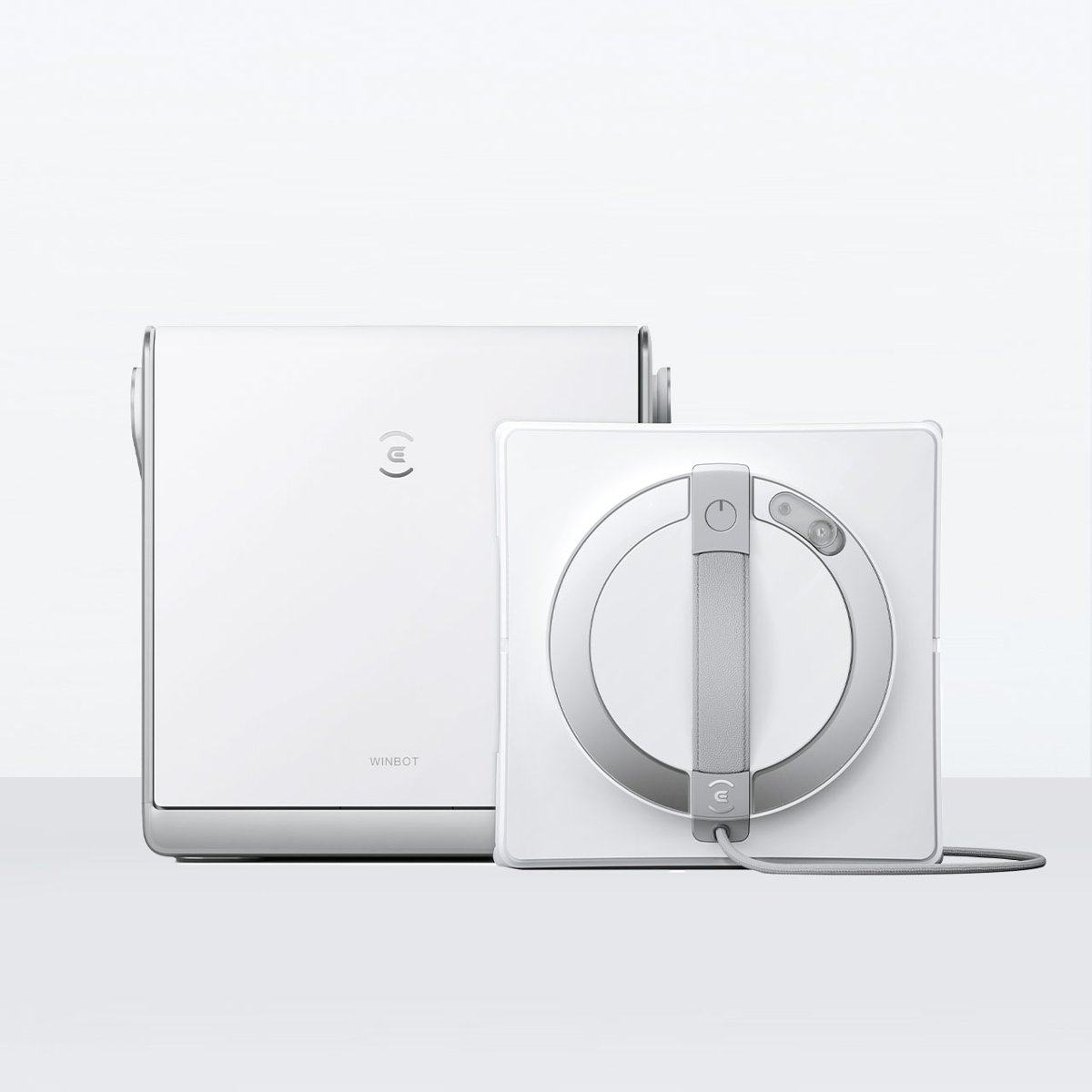
Ecovacs Winbot W2 Omni — the premium, cordless-while-cleaning pick
The Ecovacs Winbot W2 Omni is the flagship most people will land on, and it’s officially sold here — NTUC FairPrice lists it at S$1,980, with the same unit available through Ecovacs’ own Singapore store.
What you’re paying for is the base station. Unlike older robots that dangle a permanent power cord to the wall, the W2 Omni runs off a portable battery station, so the robot itself operates without being leashed to a power socket during a clean. For Singapore windows that’s a real advantage: you’re not fishing a mains cable across a bay window or out past a grille. It also means a wall power cut doesn’t instantly kill it mid-pane — a meaningful safety upgrade given how the whole risk here is the robot staying stuck.
The rest of the package is mature: intelligent route planning with cleaning-path memory, automatic return to the start point, and power-off protection that keeps the unit clamped to the glass if something goes wrong. Ecovacs rates it for all window types — floor-to-ceiling, small panes, frameless and even tilting windows — which covers basically every HDB and condo configuration you’ll encounter. The W2 family uses strong vacuum suction (the step-up W2 Pro Omni is rated around 5,500Pa) to stay planted, and it sprays cleaning fluid onto the pad rather than relying on a dry wipe.
Is S$1,980 a lot for a window cleaner? Absolutely. But if you’ve got a condo full of large frameless glass that no one has cleaned since you moved in, it’s competing with the cost of professional rope-access cleaners who charge per visit and need re-booking every few months. The Winbot is a one-time buy that you can run whenever the haze rolls through.
HOBOT S7 Pro — the corner specialist for framed HDB windows
If your windows are the more typical Singapore setup — aluminium-framed casement or sliding panes with proper 90° corners — the HOBOT S7 Pro deserves a hard look. TechRadar, in its HOBOT S7 Pro review, calls it “a big help for big windows,” and the design choice that matters is the shape: it uses a square cleaning pad instead of the round or D-shaped pads rivals use. Square pads physically reach into the corners that circular designs leave dirty, so you get fuller coverage right up to the frame.
The S7 Pro pairs that with an ultrasonic spray system that atomises water into an ultra-fine mist (around 15-micron droplets) for even wetting without drips, roughly 4,800Pa of suction to grip the glass, and a dual-mop “hand-wiping” polishing action that does a genuinely streak-free job. It’s rated for both indoor and outdoor use and framed or frameless glass.
There’s no official Singapore distributor pricing as clean as the Winbot’s, but the S7 Pro lists around US$439 internationally, which lands roughly in the S$600 region once imported — typically via Amazon. That’s a big saving over the Winbot if you don’t need the cordless base station. The trade-off is you’ll be managing a power lead, so plan your nearest socket and always clip the safety rope before it goes on an exterior pane.
HOBOT-2S — the sensible mid-range that’s actually stocked locally
The HOBOT-2S is the easiest model on this list to actually buy in Singapore — it’s listed on Amazon.sg and ships locally, no grey-import gymnastics. It’s a step down from the S7 Pro but keeps the feature that matters most for our dirty glass: dual ultrasonic water-spray nozzles that mist the pane before the pads wipe it, so it lifts grime instead of just smearing it around.
You also get AI route planning (it maps the pane and picks an efficient pattern rather than wandering), edge-detection sensors so it knows where the glass ends, and control via either the bundled remote or a smartphone app. Suction and pad design aren’t quite at S7 Pro level, and the corner coverage is good rather than perfect, but for everyday HDB windows it’s the pragmatic middle choice. Budget a few hundred dollars — it sits well below the Winbot, and being on Amazon.sg means easy returns if it doesn’t suit your window grilles.
Mamibot W120-T — the budget workhorse with a built-in UPS
Rounding out the line-up, the Mamibot W120-T (sold as the iGLASSBOT) is the value pick for people who want clean exterior glass without spending flagship money. It runs about 3,000Pa of suction — enough for typical panes — with three AI cleaning patterns (Z, N, and a Z-to-N combo) and a claimed pace of roughly 2.5 minutes per square metre.
Its standout for nervous high-rise owners is the built-in UPS battery, which keeps suction alive for up to 20 minutes if mains power drops — so a flicker in your block’s supply won’t send it sliding. It’s corded for normal operation (the battery is a backup, not the main power source), and you control it by remote or the free iOS/Android app. It’s not as polished as the HOBOT or Ecovacs units, and dry-climate reviewers note it’s basic, but for streaky tropical windows that just need regular de-griming, it punches above its price. Stock in Singapore is patchier than the others, so you may be importing via Amazon — check the plug and warranty before buying.
How to actually use one safely on a Singapore high-rise
The robot is the easy part. Doing it safely on the 25th floor is where people get complacent, so a few hard rules:
- Always clip the safety rope to something solid indoors before the robot goes onto an exterior pane — a window grille, a heavy piece of furniture, anything that won’t move. The rope is your last line of defence if suction fails. A robot dropped from height isn’t just a S$2,000 write-off; it’s a lethal projectile and a serious “killer litter” offence.
- Start on the inside. Run it on interior glass a few times to learn its behaviour and confirm the suction holds on your specific window before you ever trust it outside.
- Mind the grilles and frames. Many HDB and condo windows have security grilles or invisible-grille wires close to the glass. Make sure the robot has clearance and that its edge sensors aren’t being confused by the framing.
- Pick a calm, dry-ish day. These robots clean best when you can spray fluid and let the pads do the work; doing exterior panes in a downpour or strong wind is asking for trouble.
- Don’t skip the inside pane. Robots clean one face at a time. For a true streak-free finish you still wipe the interior surface yourself — which, mercifully, is the safe and easy side.
So which one should you buy?
For most Singapore households, the honest answer comes down to your windows and your budget:
- Big condo with frameless or floor-to-ceiling glass, and you hate cords? The Ecovacs Winbot W2 Omni (S$1,980) and its battery base are worth it. It’s the most hands-off, and it’s officially supported here.
- Standard framed HDB casement/sliding windows where corners matter? The HOBOT S7 Pro (~S$600 imported) and its square pad give the best edge-to-edge clean for the money.
- You want something you can buy and return locally today? The HOBOT-2S on Amazon.sg is the no-fuss mid-range pick with proper ultrasonic spray.
- Tight budget, just need the grime gone? The Mamibot W120-T does the job, and its UPS backup is a nice safety touch.
Whichever you choose, treat it as one piece of a properly thought-out home rather than a magic wand — the same way you’d plan locks, sensors and hubs. If you’re still building out the rest of your setup, our smart home getting-started guide over at HomeSmart is a good place to start, and window-cleaning robots are a genuinely useful addition for older residents ageing in place who should never be climbing on anything to reach a high pane.
Robot window cleaners won’t replace a professional deep-clean of a heavily neglected façade. But for keeping your hard-to-reach exterior glass clear month to month — without anyone leaning out of a 25th-floor window — they’ve finally earned their place in the Singapore smart home.