If you’ve spent the last few years building out a Singapore smart home — Aqara sensors here, a smart lock there, maybe a few Matter bulbs — there’s a good chance the one thing still bugging you is the talking part. Voice control was supposed to be the magic interface. Instead, most of us ended up with a smart speaker that ships every “Hey Google, turn off the kitchen lights” to a data centre overseas, adds a half-second of cloud lag, and occasionally announces that the service is “having trouble” when your home internet hiccups.
In 2026, there’s finally a credible way out: voice assistants that run locally, inside your own home, with no cloud account required. The headline product is the Home Assistant Voice Preview Edition, and after living with the idea for a while, I think it’s the most interesting smart home gadget Singaporeans can buy right now — with some big caveats. Let’s get into who should actually buy one, and who’s better off sticking with the speaker they have.
Why “local voice” suddenly matters
Every mainstream smart speaker — Apple’s HomePod mini, Google’s Nest range, Amazon’s Echo — does its heavy lifting in the cloud. Your spoken command gets recorded, uploaded, transcribed on a remote server, interpreted, and the result sent back. That works brilliantly until it doesn’t: your fibre drops, the service has an outage, or you simply don’t love the idea of an always-on microphone piping audio to a foreign server.
Local voice flips that. Speech-to-text, intent matching, and the command itself all happen on hardware sitting in your flat. The practical wins for a Singapore home:
- It keeps working when your internet doesn’t. Useful here, where a single Wi-Fi blip shouldn’t stop you turning off the aircon.
- Nothing leaves the house. No voice recordings on someone else’s server, no account profiling.
- It’s fast for the basics. Turning on lights or a fan can happen almost instantly because there’s no round trip to a data centre.
The trade-off, and it’s a real one, is that local hardware isn’t as clever as a billion-dollar cloud. More on that below.
The hero: Home Assistant Voice Preview Edition
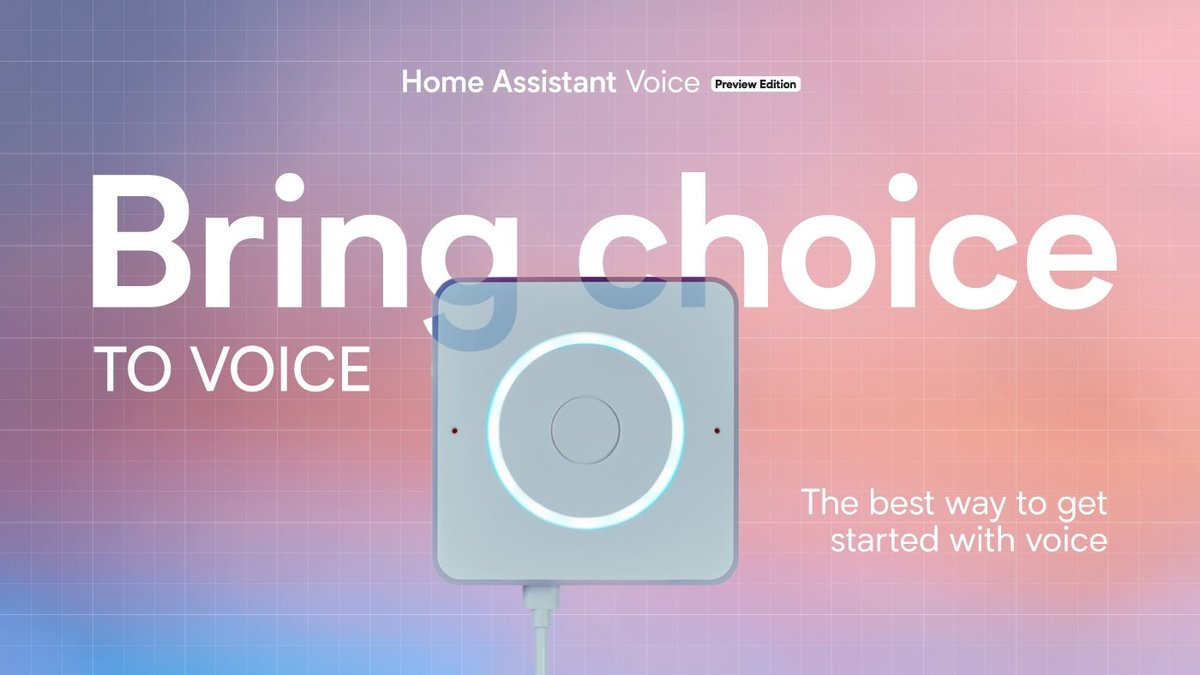
The Home Assistant Voice Preview Edition (everyone just calls it “Voice PE”) comes from Nabu Casa, the company behind the open-source Home Assistant platform. It launched in late 2024 and has matured steadily since. At a recommended US$69 (roughly S$95–S$120 once you factor shipping and GST, depending on the retailer), it’s not an impulse buy, but it’s in the same ballpark as a mid-range smart speaker.
What you get is a compact, genuinely nicely-made puck with a dual-microphone array, an XMOS audio processor for noise handling, a small built-in speaker, a physical volume dial, a mute switch, and — crucially — a 3.5mm audio jack so you can pipe it into a better speaker. There’s even a Grove port for adding sensors. It runs on ESPHome, so it’s hackable to its core.
The catch: it needs a brain
Here’s the part the marketing glosses over. Voice PE is a microphone and speaker endpoint, not a self-contained assistant. It needs a Home Assistant server somewhere on your network to do the actual thinking. That means a Raspberry Pi, an old mini PC, or a purpose-built box like Home Assistant Green or Yellow.
If you already run Home Assistant — and plenty of Singapore enthusiasts do, often on an Aqara Hub M3 or a dedicated controller — Voice PE is close to plug-and-play. If you don’t, factor the cost and weekend of setup into your decision. This is not a HomePod you unbox and talk to in five minutes.
How good is the voice, really?
Honest answer: good for control, not yet great for conversation. Out of the box you pick a wake word — “Okay Nabu,” “Hey Jarvis,” or “Hey Mycroft” — detected entirely on-device. For straightforward commands (“turn on the study lights,” “set the bedroom aircon to 24 degrees,” “is the front door locked?”), it’s reliable and the response is local and quick.
Push it toward general questions or natural, rambling phrasing and the limits of fully-local processing show. Reviewers consistently note that purely local responses can take several seconds, and that complex requests trip it up far more than a cloud assistant would. Nabu Casa’s answer is a clever middle path: a Home Assistant Cloud subscription (around US$8/month, or US$80/year, which also funds the project) offloads just the speech processing to a privacy-first cloud for snappier, smarter results — or you can wire in your own large language model if you’re feeling adventurous. You choose where on the privacy-versus-polish dial you want to sit, which is exactly the point.
The mainstream alternatives — and where they stand in Singapore
Local voice is the exciting story, but it’s not the right answer for everyone. Here’s how the off-the-shelf options actually stack up for a Singapore buyer in 2026.
Apple HomePod mini — S$139
The HomePod mini remains the most painless pick if you’re an iPhone household. It’s officially sold here at S$139 on Apple’s Singapore store, sounds far better than its size suggests, and doubles as a Matter controller and Thread border router — genuinely useful if you’re building out a Matter setup. Siri does its processing in the cloud, so the privacy and offline caveats apply, and Siri still trails Google and Alexa at actually understanding you.
One timing note: HomePod mini has been on the market a while, and there’s been persistent talk of a refresh (possibly with a screen) later in 2026. If you can wait, it may be worth seeing what Apple announces before buying. If you want one purely as a cheap Thread border router and AirPlay speaker, it’s still a solid buy. For whole-home sound, I’d point you to a proper multi-room audio setup instead.
Google Nest — fading away
Google’s smart speakers are in an awkward spot. The Nest Mini has quietly disappeared from Google’s own storefront in some regions with no like-for-like replacement, and the broader Nest audio line has stalled. Google Assistant is still excellent at understanding natural speech, but I’d be cautious about investing in a hardware ecosystem the company seems to be deprioritising. In Singapore these are increasingly grey-import or clearance buys rather than confidently-stocked products.
Amazon Echo — the grey-import problem
Alexa is arguably still the best at sheer voice comprehension and has the widest device support. The snag for us is that Amazon doesn’t officially sell its devices in Singapore — there’s no local Amazon hardware store — so every Echo here is a grey import. That means no local warranty, occasional regional account friction, and the same cloud-dependency as everyone else. Functional, but not the clean experience it is in the US.
So which should you actually buy?
Let me be opinionated, since that’s what you came for.
Buy the Home Assistant Voice PE if: you already run (or are excited to run) Home Assistant, you care about privacy and offline reliability, and you enjoy tinkering. For this crowd it’s a no-brainer and easily the most satisfying voice gadget of the year. Pair it with local-first gear — Matter and Thread devices, an Aqara Hub M3 acting as a local controller — and you get a smart home that genuinely keeps working when the cloud doesn’t.
Buy the HomePod mini if: you’re an iPhone family that wants something that works out of the box, sounds great, and quietly strengthens your Matter/Thread network. Just keep one eye on a possible 2026 refresh.
Think twice about Nest or Echo: not because they’re bad, but because the local support and stocking situation in Singapore makes them harder to recommend with confidence right now.
If you’re earlier in the journey and still deciding which platform should be the “brain” of your home in the first place, that’s worth settling before you pick a microphone — I went deep on SmartThings vs Google Home vs Apple Home for HDB living in a separate piece, and it’s the better starting point if you’re building from scratch.
A few HDB and condo realities
Some practical notes specific to flats here before you commit:
- Wi-Fi band matters. Voice PE and most budget speakers are 2.4GHz only. In a dense HDB block with crowded 2.4GHz airwaves, place the device with line-of-sight to your router or a mesh node for reliable wake-word response.
- Tropical “always-on” wear. These run 24/7 in a warm climate. Give them airflow — don’t bury a speaker in a closed cabinet — and they’ll last longer.
- Match the protocol. Voice control is only as good as the devices behind it. If your kit speaks Matter, Thread, or Zigbee through Home Assistant, local voice can control all of it. If half your home is on cloud-only Wi-Fi gadgets, those commands still need the internet regardless of how local your speaker is. Getting your devices onto a common standard is the real unlock — and a good place to start is a simple getting-started smart home guide before you spend on voice.
The verdict
For most of the last decade, “smart speaker” and “cloud-dependent always-on mic” were the same thing, and you took it or left it. In 2026 that’s no longer true. The Home Assistant Voice Preview Edition isn’t perfect — it needs a server, the fully-local mode is slower than the big cloud assistants, and it asks more of you at setup — but it’s the first time a privacy-respecting, offline-capable voice assistant has been good enough to genuinely recommend to Singapore smart home owners. If you value control over convenience, this is the most exciting S$100-ish you can spend on your home this year. If you just want something that works the moment you plug it in, the HomePod mini is still the safe, officially-supported pick.
Either way, the era of “your voice assistant only works when a foreign data centre says so” is finally ending. About time.